
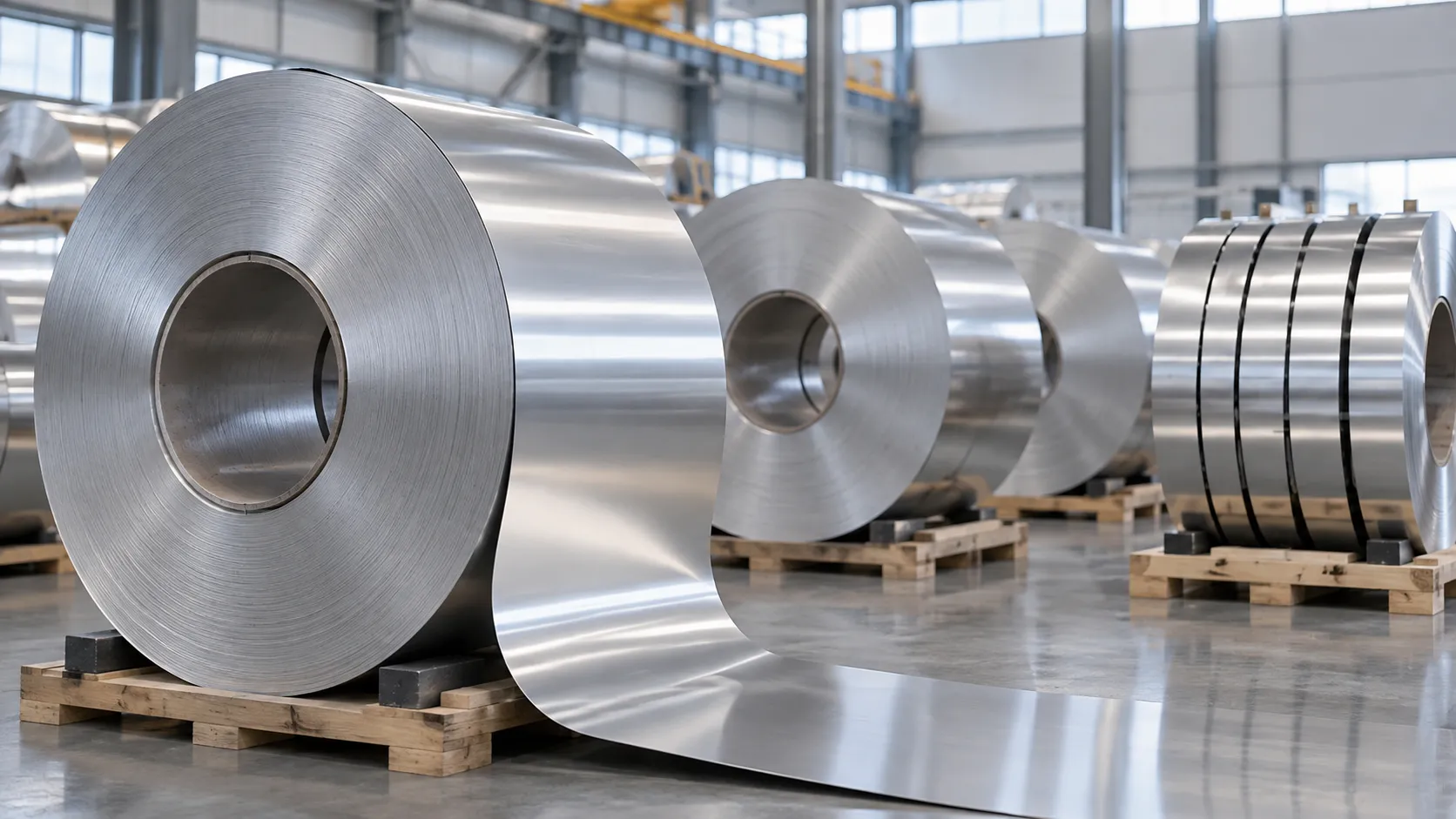
3003 alloy aluminum coil is an Al-Mn, non-heat-treatable material used where formability and corrosion resistance matter. But a B2B buyer cannot build a reliable quotation around the words “3003 aluminum coil” alone. The application, material condition, thickness, width, surface requirement, downstream forming process, coil handling conditions and order scope all affect what the supplier should quote. TOP METAL’s current 3003 Aluminum Coil information also connects the alloy with humid-environment uses, refrigerator and air-conditioner ducts, mechanical parts, external packing, trim, ornamental work and structural applications. The useful procurement question is therefore not only whether 3003 is available, but whether the quoted coil matches the buyer’s actual forming and production requirements.
What Is 3003 Alloy Aluminum Coil Used For?
TOP METAL describes 3003 aluminum coil as an Al-Mn alloy with good corrosion resistance and useful formability. Its current product information identifies applications including refrigerator and air-conditioner ducts, mechanical parts, external packing, trim, ornamental components and structural uses. These applications are not interchangeable from a purchasing perspective. A coil intended for duct forming may be evaluated differently from material intended for decorative trim or a mechanical component.
That distinction matters because application is the starting point for the rest of the specification. If the coil will be bent, rolled, stamped or formed, the buyer must define the fabrication route before comparing offers from a 3003 aluminum coil manufacturer. If the application is mainly decorative, surface appearance may become more important. If the coil will operate in a humid environment, the buyer may focus on the alloy’s corrosion-resistant use case while still defining the required dimensions and fabrication condition.
Buyers who are still defining the product family can first review TOP METAL’s Aluminum Coil category, then move to the specific 3003 product once the application is clear.
Start With the Forming Requirement, Not Just the Alloy Number
One of the most useful facts in TOP METAL’s 3003 product information is that 3003 is non-heat-treatable and its mechanical behavior changes through cold processing. The same source describes high plasticity in the annealed condition, good plasticity in a semi-cold-hardened condition, and lower plasticity after cold hardening. For procurement, this means the condition of the material is not a secondary detail. It can change how the coil behaves in a downstream forming process.
A buyer preparing an RFQ should therefore start with the fabrication operation. Will the material be roll formed into a duct? Will it be stamped into a component? Will it be bent into trim? Will it be cut and used without major deformation? These questions create a clearer specification path:
This sequence is more useful than asking several suppliers for “3003 coil” and comparing prices before confirming whether they are offering the same condition.
Why Material Condition Matters in a 3003 Aluminum Coil RFQ
A material condition affects more than a label on the quotation. It influences how much forming the coil can tolerate and therefore how well it fits the buyer’s production route. TOP METAL’s published 3003 information supports the general relationship between annealed, semi-cold-hardened and cold-hardened conditions, but it does not publish a complete condition-by-condition specification for every possible 3003 coil order. Buyers should therefore avoid assuming a condition from the alloy number alone.
For a practical RFQ, the buyer can define the required forming outcome and ask the supplier to return the offered condition as part of the technical quotation. This is especially important for procurement teams comparing multiple 3003 aluminum coil suppliers. If Supplier A quotes one material condition and Supplier B quotes another, the offers may not represent the same manufacturing requirement even if both use the same alloy designation.
Thickness and Width Should Follow the Finished-Part Requirement
Thickness and width are basic dimensions, but they should not be treated as isolated purchase fields. They are linked to the geometry of the finished part and to the buyer’s downstream processing route. A strip that will be roll formed into a narrow duct component has a different width requirement from a coil that will be slit into several production lanes.
A more useful specification chain is:
This is why “standard width” is not always a meaningful buying instruction. If the buyer’s line requires a defined strip width, that value should be written into the RFQ. If the material will be slit after delivery, the buyer should state the incoming coil requirement and the planned conversion route. This helps the supplier understand whether the quote is for a finished-width coil or for material that will be processed later.
The same principle applies to thickness. The project drawing, forming requirement or approved material specification should define the required thickness. A supplier quotation should then state the offered value and any relevant tolerance or deviation rather than leaving the buyer to infer it from a general product page.
Surface Requirements Depend on How the Coil Will Be Used
TOP METAL’s product information identifies trim and ornamental applications as well as more functional uses such as ducts, mechanical parts and external packing. These application groups can create different surface expectations.
Visible and decorative applications
For trim or ornamental use, appearance may be part of the acceptance criteria. The RFQ can define whether the finished surface will remain visible, whether handling marks are acceptable, and whether the buyer expects a specific finishing route after fabrication. TOP METAL’s 3003 product information also notes that the alloy responds to mechanical and organic finishing, which makes it reasonable for buyers to define the downstream finishing process before finalizing the material order.
Functional or concealed applications
For a duct, internal mechanical part or packaging component, the surface decision may be driven more by forming, cleanliness or downstream processing than by decorative appearance. The buyer should still define the required condition, but the acceptance standard may be different from a visible trim application.
The important point is that surface requirements should come from the final part, not from a generic expectation attached to the words “3003 aluminum coil.”
What Coil Handling and Uncoiling Requirements Should Be Defined?
The keyword 3003 alloy aluminum coil also leads to a practical production question: how will the coil be handled and fed into the buyer’s line? This is especially relevant for buyers sourcing material for repeated slitting, stamping or roll-forming operations.
If the production line has fixed handling limits, the RFQ should state them rather than assuming that any coil configuration will work. Relevant buyer-side inputs can include:
- the incoming coil form required by the production line;
- maximum acceptable coil weight where lifting or decoiling equipment has a limit;
- inner or outer diameter requirements when these are fixed by the line;
- winding or edge requirements that affect stable feeding;
- slitting requirements where the supplier is expected to supply finished strip widths;
packaging and handling requirements needed to protect the coil during transport and storage.
These are not universal 3003 values, and TOP METAL’s current 3003 product page does not publish one standard configuration for every order. They are RFQ variables that should be supplied by the buyer when they materially affect production. This is the difference between a broad request for wholesale 3003 aluminum coil and a specification that a supplier can quote against without making assumptions.
How Should Buyers Compare 3003 Aluminum Coil Quotations?
The safest comparison method is to normalize the technical scope first. A lower price may simply reflect a different condition, width, surface or processing scope. The following table shows a practical comparison structure.
| RFQ Variable | Buyer Should Define | Supplier Should Return |
|---|---|---|
| Alloy | 3003 | Offered alloy |
| Application | Final use and fabrication route | Configuration offered for that use |
| Material condition | Required forming behavior or specified condition | Offered condition |
| Thickness | Required thickness from drawing/specification | Offered thickness and relevant tolerance basis |
| Width | Finished width or incoming coil width | Offered width and processing scope |
| Surface | Visible, functional or downstream-finished requirement | Offered surface condition |
| Coil handling | Line limits if they are fixed | Offered coil configuration |
| Quantity | Required order quantity | Commercial quotation basis |
The table is useful because it forces each aluminum coil 3003 supplier in China to respond to the same technical question. Once the alloy, condition, thickness, width, surface and coil scope are aligned, price comparison becomes much more meaningful.
What Evidence Should Accompany a 3003 Coil Quote?
Evidence should prove that the quotation matches the requested material, not simply add paperwork. Depending on the project, buyers can ask the supplier to return a product specification or written technical confirmation that identifies the offered alloy, condition, dimensions, surface and processing scope. If the buyer has issued a drawing or specification, the supplier should also identify any deviation before order placement.
For visible or forming-sensitive applications, a sample or agreed finish reference may be useful when appearance or fabrication response is critical. The purpose is not to collect documents for their own sake. It is to reduce the gap between the material the buyer thinks was quoted and the material the supplier actually intends to deliver.
How to Build a Usable 3003 Aluminum Coil RFQ
A strong RFQ can be concise if the right fields are included. For TOP METAL or another 3003 aluminum coil manufacturer, the buyer should normally define:
- the final application;
- 3003 alloy requirement;
- required condition or forming requirement;
- thickness;
- width or strip width;
- surface requirement;
- downstream forming, stamping or roll-forming process;
- coil handling limits where relevant;
- quantity;
- packaging or documentation requirements that affect the order.
TOP METAL’s dedicated 3003 Aluminum Coil page can be used as the product reference during evaluation. Once the application and specification are defined, buyers can submit the same technical fields through the Request Quote page so the quotation is based on a clear material and processing scope rather than a generic alloy name.