
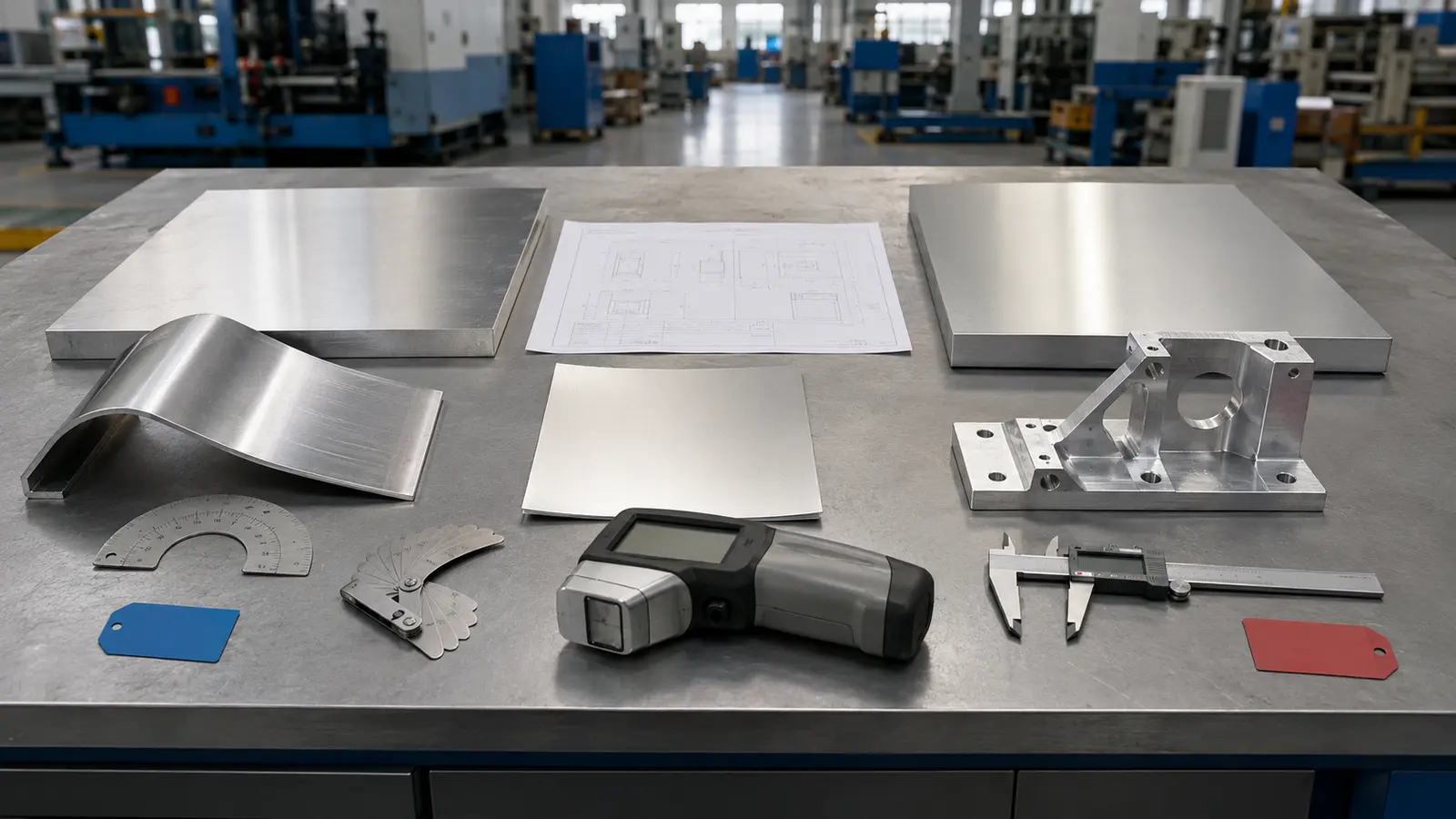
6061-T4 and 6061-T6 are not different aluminum alloys; they are different temper conditions of alloy 6061. Buyers should not treat T6 as a universally “better” version of T4. The correct temper depends on where the sheet enters the manufacturing route, whether forming or other processing remains after delivery, what condition the finished part must meet, and who is responsible for any later heat treatment. A usable RFQ should identify 6061 + temper + thickness + dimensions + fabrication route + final application + required standard and evidence. Without those fields, suppliers may quote materially different conditions under the same general description of “6061 aluminum sheet.”
What Is the Practical Difference Between 6061-T4 and 6061-T6?
6061 identifies the alloy. T4 and T6 identify temper conditions created through different processing histories. For purchasing purposes, the final material definition is not simply “6061.” It is the combination of alloy, temper, product form, dimensions, applicable requirements and delivery condition.
The temper influences how buyers review mechanical-property requirements, forming and fabrication, machining, welding, dimensional stability and final acceptance. Those effects cannot be reduced to a single property number that applies to every sheet and plate thickness. Formal material systems manage alloy and temper together with mill-product form, dimensions and property limits, so the RFQ needs the same discipline.
T4 may be considered where subsequent forming or processing remains part of the production route, while T6 is commonly evaluated where the delivered material is expected to meet a higher-strength final condition. The actual choice must follow the drawing, fabrication sequence and specified property requirements. This is a decision boundary, not a rule that every formed part requires T4 or every load-bearing part requires T6.
Buyers who are still defining the product form can begin with the TOP METAL aluminum sheet range. The category page establishes sheet as the relevant form, but it does not replace the project drawing or confirm that every alloy-temper-size combination is available for a particular order.
Start With the Final Part, Not the Temper Name
The first procurement question should not be “T4 or T6?” It should be “What will this sheet become?” A structural plate, machined component, bracket, base plate, vehicle component, marine part, fabricated panel, welded assembly and component requiring later forming can all begin with 6061, but they do not share one manufacturing route or acceptance condition.
Consider two orders with the same nominal alloy and thickness. In the first, the buyer cuts the sheet and directly machines a finished component. In the second, the buyer bends, forms or welds the material and then performs additional processing before final inspection. The point at which temper is specified, the expected dimensional behavior and the party responsible for the final condition may differ substantially.
The drawing should therefore identify the final part and its governing requirements. The process plan should show whether the delivered sheet will be cut, bent, formed, machined, welded, heat treated, surface finished or combined with other parts. Purchasing can then ask suppliers to quote the material condition that fits that route instead of selecting a temper from a short comparison chart.
Which Variables Should Buyers Compare Before Choosing T4 or T6?
| Buyer decision | What to confirm for 6061-T4 or T6 | Why it matters | Evidence to request |
|---|---|---|---|
| Final application | Finished-part use, loads and operating environment | Defines the required final material condition | Drawing or material specification |
| Fabrication route | Cutting, bending, forming, machining and welding sequence | Later operations may change the temper decision | Approved process route |
| Final mechanical requirement | Properties required by the drawing or governing specification | Prevents purchasing by alloy name alone | Material specification and MTC |
| Thickness and dimensions | Thickness, width, length and tolerances | Availability and property limits cannot be separated from size | Quotation and dimensional confirmation |
| Delivered temper | T4, T6 or another approved condition | Keeps quotation and purchase order consistent | Quotation, PO and MTC |
| Post-processing | Any later heat treatment, forming or finishing | Establishes responsibility for the final condition | Written process responsibility |
| Sample or trial | Whether a new fabrication route needs validation | Avoids judging production performance from a material name | Sample and fabrication-trial record |
The table intentionally avoids one-size-fits-all strength and elongation values. Mechanical-property limits need to be checked against the applicable standard, product form, temper, thickness and edition. If a number is important to acceptance, put the correct value and source in the drawing or material specification rather than copying it from a generic web comparison.
When Can T4 Be the Better Procurement Starting Point?
T4 may be a practical starting point when the delivered sheet still needs significant shape development or when the buyer is qualifying a manufacturing route. Examples can include bending, forming, a production trial or another subsequent operation. In these cases, the purchasing team may care more about how the delivered condition fits the next manufacturing stage than about receiving the material in the highest-strength condition being considered.
This does not mean T4 is automatically suitable for any bend radius, formed geometry or fabrication method. The drawing must state the geometry and critical requirements. The process engineer should review tooling, forming direction, thickness, bend radius, springback, surface marking and the effect of later operations. Where risk is meaningful, representative trials should use the intended sheet condition and production-like tooling.
The final condition of the part also remains essential. If the production plan includes subsequent heat treatment, the RFQ and process documentation should identify who performs it, which condition is required afterward and what evidence confirms it. Purchasing T4 without a controlled path to the required final condition leaves the order incomplete.
A defensible T4 decision therefore comes from four linked inputs: the drawing, forming requirement, engineering approval and final property requirement. Removing any one of them can create a gap between the material delivered by the supplier and the component accepted by the buyer.
When Does a Buyer Need the Final T6 Condition?
Begin this decision from final acceptance. If the buyer expects the delivered sheet itself to meet the specified T6 condition before machining, assembly or use, then “6061-T6” must appear consistently in the RFQ, quotation, purchase order and applicable material documentation. Writing only “6061” does not communicate the required delivered condition.
The RFQ should combine 6061-T6 with thickness, width, length, tolerances, applicable material specification, required property documentation, surface condition, flatness or dimensional requirements where relevant, and traceability expectations. Suppliers can then confirm the exact scope or identify a deviation before the buyer compares price.
T6 may also be evaluated for parts that will be machined from the delivered sheet and accepted in that condition. Even then, the buyer should assess machining strategy, residual-stress or distortion concerns, part geometry and any later welding or thermal exposure. The temper designation confirms a material condition; it does not promise that every machining sequence will produce a distortion-free component.
If fabrication after delivery can alter the material condition or local properties, final engineering requirements must address that effect. The buyer should not use an incoming T6 certificate as a substitute for finished-part qualification where the manufacturing route changes what the part experiences.
Why Should Buyers Separate Material Condition From Fabrication Performance?
Material specification answers the question: “What aluminum sheet was received?” It can define alloy, temper, thickness, dimensions, surface condition and material records. These fields establish the purchased material and provide a basis for incoming inspection.
Fabrication performance answers a different question: “How does this batch behave in the buyer’s process?” Relevant observations may include bend results, springback, cracking, machining behavior, distortion, weld-related behavior and finished-part dimensions. These results depend on both material and process variables.
An MTC can support alloy and temper verification for the supplied batch, subject to the agreed document scope. It does not guarantee the result of any bending, machining or welding conditions the buyer may choose. Tool condition, geometry, cutting strategy, heat input, restraint and process control can all influence the finished result.
The reverse is also true. A sample that bends or machines successfully does not replace alloy, temper and traceability documentation for the production batch. The sample proves that one material-process combination worked under recorded conditions. Production acceptance still needs a controlled material definition and evidence linked to the delivered lot.
What Can Go Wrong If the RFQ Says Only “6061 Aluminum Sheet”?
Risk 1: The quotations are not comparable
Supplier A may quote 6061-T4 while Supplier B quotes 6061-T6. Both responses appear to satisfy the general alloy description, but their delivered conditions and commercial scopes differ. A price comparison made before aligning temper, size, tolerance and documentation is not a like-for-like comparison.
Risk 2: The material condition conflicts with the manufacturing route
The buyer may specify a final property target without explaining that the sheet will first be formed, welded or otherwise processed. Alternatively, the buyer may select a delivery temper for manufacturing convenience but omit responsibility for achieving and verifying the final condition. Either gap can stop engineering approval after the order has already been placed.
Risk 3: Incoming inspection has no agreed basis
If the purchase order states only “6061 aluminum sheet,” purchasing, quality and the supplier have no shared answer to a basic question: which temper should be accepted? Dimensions and surface may be correct while the required material condition remains undefined. The resulting dispute cannot be solved by checking the alloy number alone.
How Should Buyers Evaluate a Specific 6061 Aluminum Sheet Offer?
TOP METAL’s 6061 aluminum sheet product page lists T4, T6 and T651 among the available temper families and also presents sheet dimensions, surface protection and referenced standards. This establishes the product family for evaluation, but it does not confirm that every temper, thickness, size and specification combination is available or suitable for a particular project.
The buyer should request a quotation for the exact combination required. Confirm whether the offer is sheet or plate, the proposed temper, actual dimensions, tolerances, surface, protection, packing and material-document scope. If the supplier proposes another condition, that proposal should appear as a deviation or alternative rather than being silently substituted.
Check the applicable specification and edition. ASTM B209/B209M covers aluminum and aluminum-alloy sheet and plate in listed alloys, tempers and dimensional ranges, but the purchase document still needs to identify the required alloy-temper-product combination and any additional project criteria. A broad reference to “ASTM” is not a complete specification.
What Should a 6061-T4 or T6 Aluminum Sheet RFQ Include?
- Application: Identify the finished component, service environment and relevant drawing.
- Alloy: State 6061 rather than a generic 6000-series aluminum request.
- Required temper: State T4 or T6, or request an engineering recommendation without authorizing an unapproved substitution.
- Thickness: Provide nominal thickness, tolerance and governing unit.
- Width × length: Distinguish stock dimensions from finished cut size and add dimensional tolerances.
- Fabrication route: List cutting, bending, forming, machining, welding and any later heat treatment in sequence.
- Final requirement: Identify the drawing, final condition and mechanical or dimensional acceptance requirements.
- Material evidence: State the required MTC, alloy-temper identification, inspection records and traceability scope.
- Surface and packing: Define the visible face, protective film, interleaving, pallet and handling expectations.
- Quantity and destination: Provide order quantity, delivery location and requested commercial basis.
Ask the supplier to return each field as Confirmed, Deviation, Alternative or Requires Review. This response format is more useful than requesting only a best price because it exposes technical and commercial differences before approval.
Frequently Asked Questions
Is 6061-T6 always better than 6061-T4?
No. The correct condition depends on the required final properties, fabrication route, delivery stage and responsibility for later processing. T6 should not be treated as a universal upgrade, and T4 should not be selected solely because forming is involved.
Can buyers order only “6061 aluminum sheet” without specifying temper?
The phrase may be used for an early inquiry, but the formal quotation and purchase order should confirm the temper. Otherwise, competing suppliers can quote different conditions and incoming inspection will lack an agreed acceptance basis.
Can 6061-T4 be replaced by T6 if the dimensions are the same?
Not on dimensional equivalence alone. The drawing, fabrication sequence, final property requirements and engineering approval must be reviewed. Any proposed substitution should be documented before the sample or order is approved.
What evidence should confirm the supplied temper?
Use the quotation, purchase order, applicable material certificate and agreed traceability documentation together. The exact document set should follow the project specification and be confirmed before ordering.
Choose the Temper From the Manufacturing Route
The correct temper is determined by where the material sits in the manufacturing route and what condition the finished part must meet. Buyers should connect 6061-T4 or T6 to the final component, fabrication sequence, dimensions, applicable specification, evidence and responsibility for later processing. That approach produces comparable quotations and an enforceable acceptance basis.
Send the required temper, thickness, dimensions, fabrication route, final application, quantity and document requirements through the TOP METAL request form. Ask the supplier to identify the offered 6061 condition and any deviations before approving the sample or purchase order.