
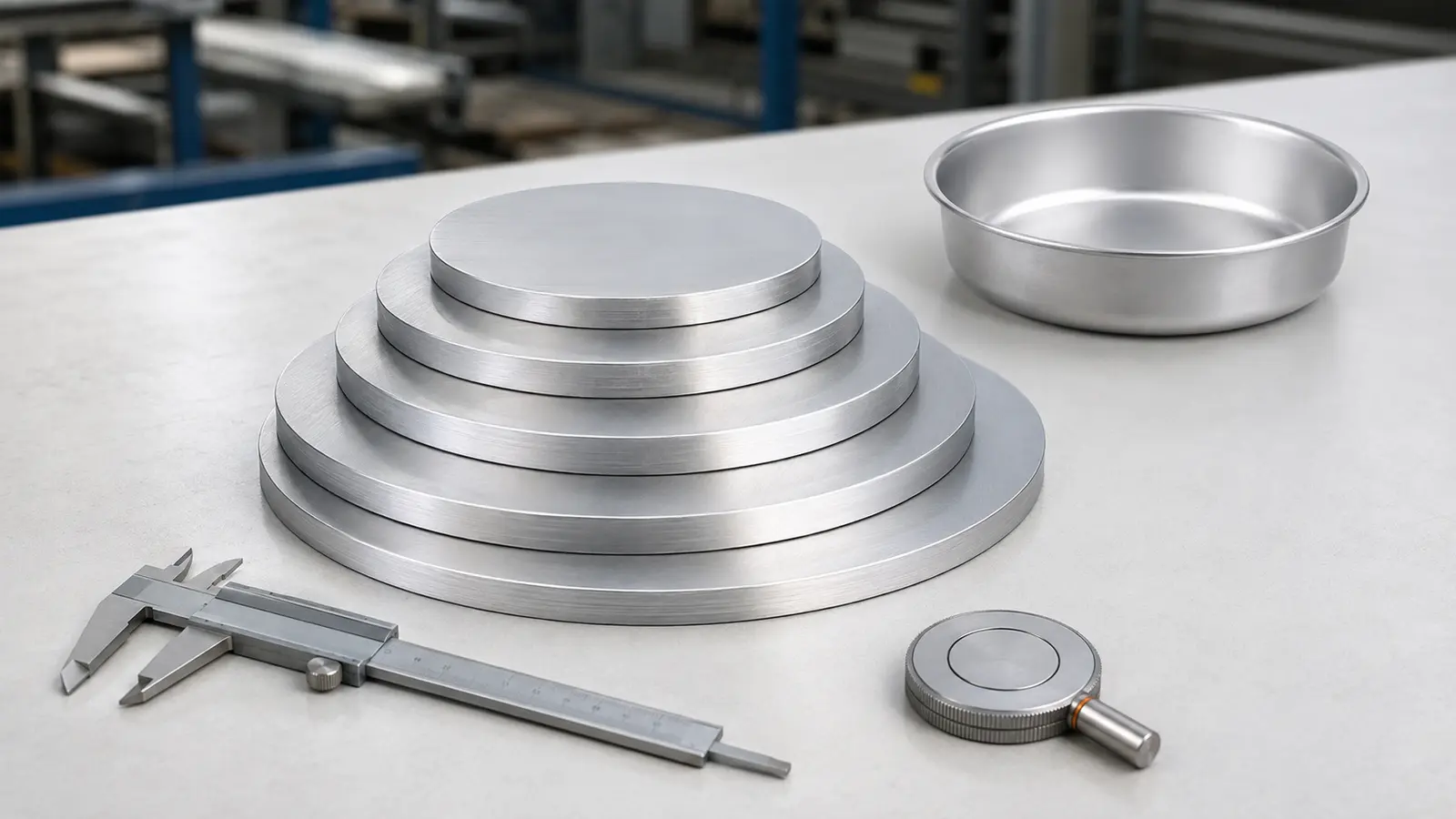
Direct Answer: Buyers should evaluate a versatile aluminum circle plate disc against the finished part and forming route, then confirm alloy, temper, thickness, diameter, dimensional tolerance, edge condition, surface protection, lot consistency, inspection, and packing. A circle that suits shallow spinning may not behave the same way in deep drawing, so the RFQ should define the actual process and acceptance method.
The word “versatile” is useful only when it describes a verified operating range. Cookware producers, metal spinners, stampers, and distributors need a repeatable blank that enters their tooling without unexpected trimming, tearing, surface marking, or handling loss. A broad alloy list or a clean product photograph does not show whether the supplied circles will fit a particular die, draw ratio, finish sequence, or production rate.
What Does “Versatile” Mean for an Aluminum Circle Buyer?
For procurement, versatility means that the circle specification is compatible with more than one downstream requirement without leaving critical variables undefined. The same circular blank may be considered for cookware, lighting components, covers, containers, or spun parts, but each application places different demands on formability, surface appearance, dimensional control, and edge quality.
The aluminum circle product range is a useful place to screen available product routes. The buyer still needs to convert the finished-part drawing into a circle specification. Diameter, thickness, alloy, temper, production route, and surface condition should be stated as separate fields rather than compressed into a description such as “general-purpose aluminum disc.”
A common purchasing mistake is to choose the blank from the finished product name alone. Two cookware parts may require different draw depth, wall distribution, trimming allowance, or surface treatment. The correct circle is the one that matches the forming sequence, not simply the one marketed for cookware.
Which Forming Route Should Control the Selection?
Deep drawing, spinning, stamping, and shallow pressing do not place identical demands on a blank. Buyers should identify the first operation, the number of forming stages, any intermediate annealing, the intended trim allowance, and whether the part will be anodized, coated, polished, or bonded after forming. Tooling teams should also state known failure modes from the current process.
The target mill-finish aluminum circle for cookware is described with 1060, 1070, 1100, and 3003 options and is positioned for drawing applications. The source data also notes that cold-rolled sheet or coil may be used as stock and that DC or CC material can be requested. Those statements identify possible supply routes; they do not establish that every alloy, temper, diameter, or forming condition is interchangeable.
Ask the supplier to quote the proposed route and temper for the stated operation. If two routes are offered, keep them as separate alternatives. Mixing the lower-priced route into the compliant offer makes it difficult to identify whether a later forming result came from tooling, material condition, or an unapproved substitution.
How Should Diameter, Thickness, and Edge Condition Be Specified?
Nominal diameter and thickness are not enough for stable production. The drawing or RFQ should include tolerances, measurement method, sampling plan, edge requirement, burr direction, permissible out-of-round condition, and any flatness or dish limit needed by the feeder or tooling. The buyer should define these requirements from the process rather than copy a generic catalog range.
Edge condition matters before the blank reaches the die. Burrs can interfere with stacking, feeding, operator handling, and the start of a draw. Rough or damaged edges can also complicate inspection because the supplier and buyer may disagree about whether the blanking operation or the forming tool caused the defect.
Procurement teams often compare cost per kilogram while the factory consumes circles by usable piece. A cheaper blank can create a higher effective cost when inconsistent diameter, edge damage, or excessive trimming reduces yield. The quotation comparison should therefore include accepted pieces, not only shipped weight.
When Do Alloy and Temper Need Separate Validation?
Alloy and temper influence formability, strength, work hardening, surface response, and downstream processing. Buyers should name the required designation and permitted alternatives, then ask how the offered condition will be documented. A supplier should not change temper or production route solely because the nominal alloy remains the same.
For the present selection decision, alloy and temper are one part of a wider system that also includes blank geometry, grain consistency, tooling, lubrication, and the forming schedule. A material choice that reduces one forming risk can still perform poorly when the blank size, edge, or process settings are wrong.
A laboratory value or certificate result should not be treated as a guarantee of forming performance in the buyer's tooling. Material documents verify specified properties and identity; production trials verify whether the complete material-and-tooling combination works under the intended process.
What Evidence Should Support a Circle Plate Offer?
| Buyer requirement | Supplier should state | Evidence before approval | Risk if left open |
|---|---|---|---|
| Forming route | Proposed alloy, temper, stock route, and intended forming suitability | Quotation, material record, and trial-lot identification | A catalog match fails in the buyer's actual tooling |
| Blank geometry | Diameter, thickness, tolerances, roundness basis, and measurement method | Dimensional report using the agreed sampling plan | Feeding, trimming, or finished-part dimensions become unstable |
| Edge quality | Blanking method, burr acceptance, edge damage limit, and handling method | Approved edge sample and incoming-inspection record | Burrs are discovered only after the line is loaded |
| Surface condition | Mill finish, cleanliness, oil condition, interleaving, and visible-face protection | Limit sample or agreed photographs under defined lighting | Handling marks are judged without a common standard |
| Lot consistency | Lot definition, traceability fields, and change-notification boundary | Material documents and package labels linked to the trial | Approved trial material cannot be linked to the bulk order |
| Packing | Stack height, separators, moisture protection, pallet construction, and marks | Packing specification and pre-shipment photographs | Circles arrive dented, stuck together, or difficult to unload |
A sample certificate demonstrates document format, not shipment conformity. The final records need to connect the delivered packages to the specified alloy, condition, and production lot. If circles from several lots are combined, the marking and document plan should make that visible.
Why Do Surface Protection and Packing Affect Usable Yield?
Mill-finish circles can pick up scratches, moisture marks, embedded particles, or edge dents during stacking and transport. The acceptable surface depends on what happens next. A part that will be polished or coated may tolerate different handling marks from a visible anodized component. Buyers should describe the visible face and later finishing step rather than demand an undefined “perfect surface.”
Interleaving paper, film, oil, or dry stacking can affect separation, cleaning, and feeding. No single method is correct for every production line. The buyer should confirm whether residual oil is acceptable, whether protective film can survive forming, and whether paper fibers or adhesive residue would disrupt later cleaning or finishing.
Package weight and stack height also influence safety and throughput. A stack that is efficient for container loading may be awkward for the buyer's lifting device or feeder. Packing design should account for unloading method, storage orientation, humidity exposure, and the number of circles needed per production batch.
How Should a Trial Order Be Connected to Mass Production?
A trial should represent the proposed production route, not a specially selected blank with no traceable relationship to the bulk order. Record the alloy, temper, stock source, lot, dimensions, edge condition, surface protection, and package method used for the trial. The trial report should also identify tooling, forming stages, lubricant, observed defects, and the accepted result.
When buyers need a more tightly defined deep-drawing option, the deep-drawing aluminum circle specification provides another product route to review. Its listed ranges and standards apply to that page and should not be copied automatically into a different order.
Mass production should follow the approved specification and change-control rule. A supplier should disclose any proposed change in alloy condition, stock route, blanking method, protective material, or package construction before shipment when the change could affect forming or acceptance.
What Can Go Wrong When a General-Purpose Circle Is Under-Specified?
Representative scenario — not a claimed customer case. A cookware producer asks for one diameter of aluminum circle and notes only that the material must be suitable for drawing. The supplier sends a clean trial stack that forms acceptably. The purchase order repeats the nominal diameter and alloy but does not identify temper, production route, burr acceptance, surface protection, or lot linkage.
The bulk shipment feeds less consistently and requires more trimming. Incoming inspection confirms the nominal diameter, yet the buyer cannot determine whether the difference comes from edge condition, material state, blanking direction, or a changed stock route. Both parties have documents, but neither has an approved baseline for the variables that affect the line.
The buyer revises the RFQ around the finished part and process. The next trial records geometry, edge, material condition, traceability, surface protection, and forming results. Commercial comparison now reflects usable yield and repeatability rather than the lowest price per tonne.
What Information Belongs in the Final RFQ?
- Finished-part application, drawing, forming method, number of stages, and known defects to avoid.
- Required alloy, temper, governing specification, and permitted alternatives.
- Diameter, thickness, tolerances, measurement method, roundness, flatness, and quantity.
- Blanking or cutting requirement, burr direction, edge acceptance, and trimming allowance.
- Mill finish, cleanliness, oil or film requirement, visible-face criteria, and downstream finishing.
- Trial quantity, trial-lot identification, approval record, and change-notification requirements.
- Material documents, inspection report, package labels, sampling plan, and release points.
- Stack size, separators, pallet and moisture protection, unloading limits, and delivery terms.
Suppliers should identify deviations beside the relevant RFQ field. A technically useful alternative may lower cost or improve availability, but the buyer needs a compliant base offer before deciding whether the alternative fits the process.
Questions Buyers Ask About Aluminum Circle Plate Discs
Is one aluminum circle suitable for both spinning and deep drawing?
Not automatically. The alloy, temper, thickness, diameter, grain response, tooling, and forming sequence must be validated for each process. A blank that spins successfully may still require a different material condition or allowance for deep drawing.
Should buyers select aluminum circles by alloy first?
Start with the finished part and forming route, then select the alloy and temper that satisfy those requirements. Alloy alone does not define formability, edge quality, surface condition, or compatibility with the buyer's tooling.
What is the difference between a sample and a production trial?
A visual sample can confirm appearance and dimensions. A production trial should use the proposed bulk route and be processed in representative tooling, with the material lot and forming result recorded for later comparison.
Why should burr direction appear in the RFQ?
Burr direction can affect stacking, feeding, handling, and the first forming contact. Stating the requirement gives both supplier and buyer a defined inspection point instead of treating edge condition as a subjective complaint.
How should buyers compare aluminum circle prices?
Compare equivalent alloy, temper, geometry, tolerance, inspection, surface protection, packing, and delivery scope. Include expected usable yield and processing loss when one offer requires more trimming, sorting, cleaning, or handling.
Can product-page ranges replace an order specification?
No. Product-page information supports initial screening. The purchase order must define the exact circle, acceptance criteria, documents, trial relationship, packaging, and any approved deviations for the buyer's application.
Request a Circle Specification and Trial Review
Send the finished-part drawing, forming route, alloy and temper requirement, diameter, thickness, tolerances, edge criteria, finish, trial quantity, inspection documents, packing limits, and annual or project volume through the TOP METAL request-for-quote page. The supplier can then review the proposed circle route against the real production process.