
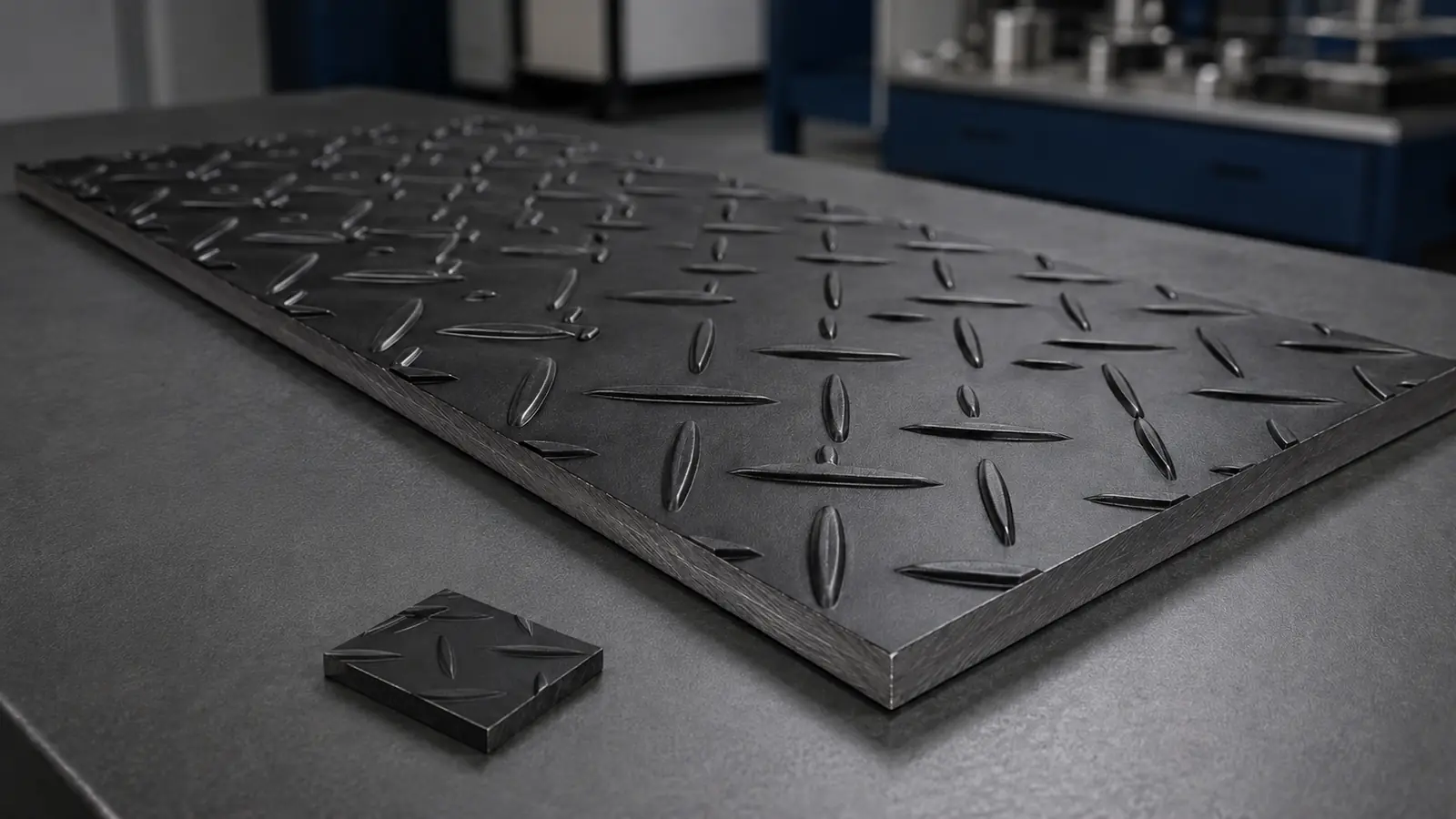
Buyers should evaluate black anodized aluminum tread plate as a complete material-and-finish specification, not as a black decorative surface alone. A workable purchase specification identifies the aluminum alloy and temper, tread pattern, thickness measurement basis, sheet or coil dimensions, anodic finish requirements, fabrication sequence, inspection method and packing condition. If any of these items remains open, two suppliers can quote products that look similar in a photograph but behave differently during cutting, bending, installation or service.
This distinction matters because “black anodized tread plate” combines three decisions in one item: the substrate, the raised pattern and the surface treatment. The safest procurement path is to separate those decisions, define how each will be verified and then reconnect them in one approved sample and one controlled order specification.
What must be defined before asking for a quotation?
A buyer does not need to write a laboratory procedure into the first inquiry. The RFQ does, however, need enough information for suppliers to quote the same scope. The following fields form a practical starting point.
| Specification area | What the buyer should state | Why it changes the offer |
|---|---|---|
| Application | Indoor or outdoor location, decorative or traffic surface, expected cleaning and fabrication | Establishes the finish, pattern and handling priorities |
| Base material | Required alloy and temper, or the performance information needed for selection | Affects strength, forming behavior, corrosion performance and anodized appearance |
| Tread geometry | Pattern type, orientation and approved visual reference | Changes appearance, contact surface and forming behavior |
| Thickness | Whether the value refers to base thickness or overall height across the raised pattern | Prevents a common source of dimensional disagreement |
| Anodized finish | Black tone, pretreatment or texture, coating class or thickness if applicable, and sealing requirement | Defines the finish beyond the word “black” |
| Dimensions | Width, length, quantity and permitted tolerances | Determines yield, processing and packing |
| Fabrication | Cutting, holes, notches, bends and whether processing occurs before anodizing | Affects exposed edges and finished appearance |
| Acceptance | Documents, sampling plan, visual standard, dimensional checks and packing inspection | Turns expectations into verifiable criteria |
Start with the application, not the color
The same black tread plate description may be used for a wall protection panel, a vehicle component, a step cover or an equipment enclosure. Those uses do not impose the same priorities. A visible interior panel may place greater weight on tone consistency and surface uniformity. A frequently handled component may need closer attention to abrasion, edge condition and cleaning. A formed part must be evaluated for bend sequence and finish behavior. A walking surface requires a project-specific assessment of pattern, installation and slip performance rather than an assumption based on appearance.
State where the part will be installed, whether water, salt, oils or cleaning chemicals are present, and whether the tread face is decorative or functional. Do not describe a surface as “anti-slip” without identifying the applicable test or project acceptance requirement. Raised geometry can improve traction in some conditions, but actual slip performance also depends on contamination, footwear, drainage, orientation and installation.
Specify the alloy and temper separately from the anodized finish
Anodizing does not replace the need to select a suitable base alloy. Alloy and temper influence strength, formability, weldability, corrosion behavior and the way a surface responds to pretreatment and anodizing. They can also affect final tone and texture. A black finish can conceal some visual differences in casual viewing, but it cannot make two substrates mechanically equivalent.
If the drawing already controls the alloy and temper, reproduce those designations exactly in the RFQ. If they are not fixed, provide the load, forming operation, exposure and appearance priorities so the supplier can return a clearly identified proposal. Buyers who are still narrowing the material can review the site’s aluminum alloy guide, then confirm the final selection against the project design and governing specification.
For rolled tread plate, the purchase standard should match the product form. ASTM B632/B632M is one recognized specification for aluminum-alloy rolled tread plate, while other regional or project standards may apply. Simply copying a sheet standard onto a tread plate order can leave pattern and measurement questions unresolved. The purchase order should name the required standard, edition where contractually important, alloy, temper and any supplementary requirements.
Define the tread pattern and the thickness measurement basis
Terms such as diamond plate, checker plate and tread plate are often used loosely. The pattern may be a single bar, multiple bars or another raised arrangement, and the direction of the pattern may matter on a visible assembly. Use a pattern name only when both parties interpret it the same way. A drawing, approved reference image or physical sample is safer for appearance-critical work.
Thickness needs equal care. A nominal value might be interpreted as the base metal thickness below the raised lugs, or as the overall thickness measured across the highest point. Those values are not interchangeable. The RFQ should state the measurement basis, the permitted tolerance and the test location. If finished part fit depends on total height, include that requirement separately.
At this stage, buyers can review the available anodized aluminum sheet category to understand the relevant product family, but the category name should not substitute for the dimensional specification. The quote must still identify the offered pattern, substrate and size.
Describe the anodized black finish in measurable terms
“Black anodized” identifies a process and a general color direction; it does not fully define appearance or performance. ISO 7599:2018 provides a method for specifying decorative and protective anodic oxidation coatings on aluminum and highlights the importance of substrate grade and pretreatment to the finished appearance. A project specification may also reference another national, customer or architectural standard.
The finish section should address the items that matter to the application:
- the required pretreatment or surface texture, such as a clean industrial finish, brushed texture or other agreed preparation;
- the target black tone and acceptable range, supported by an approved master sample where appearance is important;
- the coating thickness class or minimum thickness when required by the governing specification;
- the sealing and any performance tests required by the project;
- which face and edges must be finished;
- whether contact marks in non-visible areas are acceptable;
- the viewing distance, lighting and comparison method used for visual approval.
Color approval deserves particular discipline. A digital image is affected by lighting, camera processing and display settings, so it should not be the only color standard. For a visible project, approve a representative physical sample and identify it by date or sample code in the purchase documents. The production acceptance rule should also explain how lot-to-lot variation will be assessed.
Decide whether fabrication happens before or after anodizing
Cutting, punching and bending can expose bare edges or alter the visual surface. Anodizing after fabrication may provide a more continuous finish on accessible surfaces, but the part geometry, racking points and process capability have to be considered. Fabricating after anodizing can simplify production for flat stock, yet cut edges and bend zones may no longer match the face.
There is no universal sequence for every project. The drawing should show the finished part, identify visible faces, locate holes and bends, and state which surfaces require black anodizing. The supplier’s quotation should then confirm the proposed sequence and declare any areas that cannot receive the same appearance. This is more useful than requesting “all edges finished” without considering how the part is made.
When the order is for flat stock rather than finished parts, clarify whether protective film is needed and whether it is compatible with the planned cutting, forming and storage process. Film type, application side and removal timing should be agreed rather than assumed.
Use a physical sample to validate the combined result
A finish coupon can confirm color direction, but a small flat coupon may not reproduce the texture and light reflection of a raised tread plate. Where appearance is critical, the approval sample should use the proposed alloy, temper, tread pattern, pretreatment and anodizing process. Its size should be large enough to show the pattern repeat and realistic surface variation.
The supplier’s black anodized aluminum checker plate page identifies the target product family. Before purchase, request a quotation that names the exact offered construction rather than relying on the product-page photograph. The approved sample, quotation and purchase order should use matching terms.
Build inspection around the risks that affect installation
Inspection should follow the drawing and purchase specification. It should not be reduced to checking whether the surface is black. For many projects, a focused incoming inspection includes:
- verification of product identification, alloy and temper documentation required by the order;
- base thickness and, when relevant, overall tread height measured by the agreed method;
- width, length, squareness, flatness or camber where these affect installation;
- pattern type, direction and consistency;
- visual comparison with the approved finish sample under agreed conditions;
- coating tests or records required by the specified anodizing standard;
- inspection for scratches, dents, stains, contact marks and edge damage;
- quantity, labels and packaging condition.
The sampling plan should identify lot definition, sample quantity and the response to a nonconforming result. If every visible panel must match closely, a general “random inspection” statement may be too weak. If the plate will be cut into small industrial parts, a practical lot sample may be sufficient. The acceptance plan should reflect the cost of failure in the actual application.
Compare quotations by declared scope, not by unit price alone
A useful comparison sheet makes supplier assumptions visible. Place each offer against the same fields and mark every deviation before commercial approval.
| Quotation field | Buyer check | Typical hidden difference |
|---|---|---|
| Material | Offered alloy, temper and governing product standard | A substitute alloy or unconfirmed temper |
| Geometry | Pattern, base thickness, overall height, width and length | Different thickness basis or usable width |
| Finish | Pretreatment, anodizing requirement, color approval and finished faces | Black coating interpreted as paint or another finish |
| Processing | Cutting, holes, bends, deburring and production sequence | Secondary work excluded from the price |
| Inspection | Documents, tests, sample approval and inspection records | Visual approval with no defined reference |
| Packing | Interleaving, film, edge protection, moisture protection and labels | Finish protection not included |
This comparison also makes technical clarification faster. Instead of asking a supplier to “confirm everything,” the buyer can ask for a line-by-line response: comply, propose an alternative, or not included. The returned quotation should identify assumptions and deviations explicitly.
What should an RFQ package contain?
For flat material, provide the application, alloy and temper, tread pattern, thickness basis, width, length, quantity, finish specification, protected face and delivery destination. For fabricated components, add a revision-controlled drawing, hole and bend details, visible-face identification, edge requirements and the intended fabrication sequence.
Ask the supplier to return the offered material designation, dimensional tolerances, finish route, sample plan, inspection documents, packing method, quotation validity and any deviations. If a physical sample is required before mass production, define who approves it and whether production may start before written approval.
A concise, complete package reduces the risk of comparing unlike offers. Buyers can submit these fields through the aluminum product request form and attach the drawing or finish reference needed for technical review.
Frequently asked questions
Is black anodized tread plate the same as black painted tread plate?
No. Anodizing forms an oxide layer through an electrochemical process, while paint or powder coating adds an organic coating. They have different appearance, edge behavior, repair options and specification methods. The purchase order should state the required finish process rather than using “black coated” as a substitute.
Should tread plate thickness be measured over the raised pattern?
Only if the specification says so. Many disputes arise because one party quotes base metal thickness and the other expects overall thickness across the raised pattern. State both values when fit or load calculations depend on them, and define the measurement method.
Can a small anodized coupon approve the production color?
A coupon can establish a useful color reference, but it may not reproduce the visual effect of the tread pattern or a large panel. For appearance-critical work, use the proposed substrate and pattern, approve a representative sample, and define production viewing and lot acceptance conditions.
Should parts be fabricated before anodizing?
That depends on geometry, visible edges and process capability. Fabrication before anodizing may improve finish continuity on accessible edges, while fabrication after anodizing may leave exposed metal at cuts and bends. The drawing and quotation should identify the agreed sequence and any unavoidable contact or unfinished areas.
Make the purchase specification do the quality work
Black anodized aluminum tread plate is easiest to buy when color is treated as one controlled characteristic within a complete specification. Begin with the application, freeze the substrate and tread geometry, define the anodized finish and fabrication sequence, and agree on inspection and packing before production. That approach gives purchasing, engineering and the supplier the same reference—and makes the final quotation genuinely comparable.