
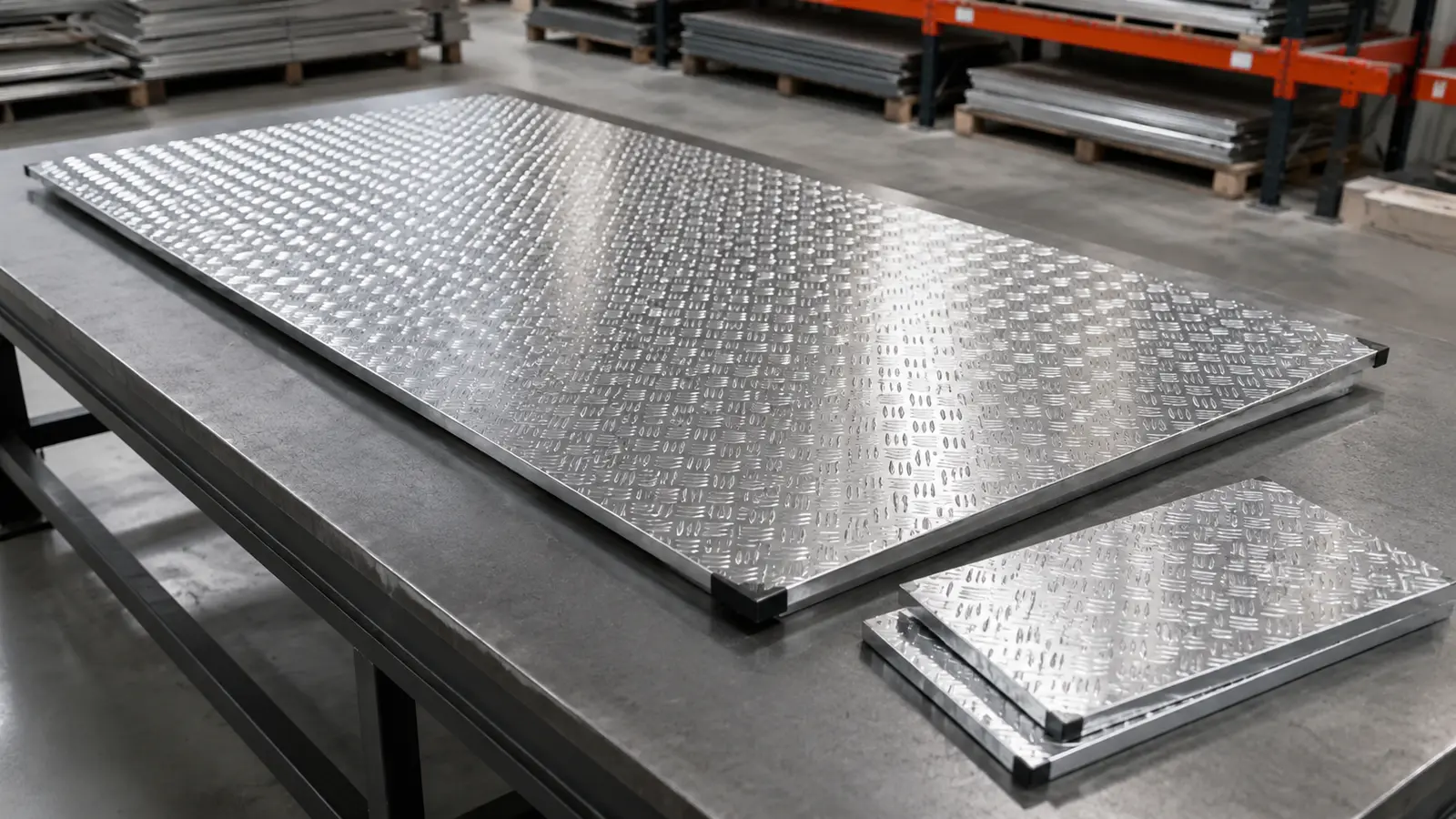
A 4x8 aluminum checkered plate order should define much more than nominal sheet length and width. Buyers need to state the alloy and temper, base-metal thickness, raised pattern, finished dimensions, quantity, application, support conditions, fabrication, visible-side requirements and inspection method. The phrase “1 thick” is especially unsafe because it may refer to 1 mm, 1/8 inch or 1 inch, and those products are not interchangeable. A comparable quotation begins with one measurement system, a drawing or dimensioned schedule, and a clear distinction between base thickness and overall thickness across the raised pattern.
Why a 4x8 size alone does not define the plate
Four feet by eight feet describes a common nominal panel footprint, but it does not identify the material that will arrive. The buyer still has to define whether 4x8 means an exact finished size, a nominal stock size that will be trimmed later, or a minimum usable area after edge removal. The quotation should use either inch-pound or metric dimensions consistently and show the permitted dimensional tolerance.
The same principle applies to thickness. Rolled tread plate has a base metal and a raised surface. A thickness value without a measurement definition can be interpreted as the thickness of the flat base, the overall height across the pattern or a nominal commercial description. For stiffness, weight and forming calculations, the engineering team normally needs the base thickness. For clearance at a joint or enclosure, the maximum overall profile may also matter.
Before contacting a supplier, buyers can review the aluminum checkered plate tread category to confirm that a raised-pattern plate is the intended product form. This prevents a smooth 4x8 sheet, embossed decorative sheet and structural grating from being grouped into the same request.
Build the specification around the finished application
A toolbox skin, vehicle floor, service walkway, stair tread and machine cover do not impose the same requirements. The application determines which questions deserve priority. A toolbox panel may emphasize appearance, forming and low weight. A walking surface may emphasize support spacing, deflection, drainage, fastening and the condition in which traction is required. A vehicle floor also needs a drawing that coordinates seams, wheel loads, fixing points and edge details.
Raised pattern can improve surface grip, but the material name alone is not a safety calculation. Slip performance depends on pattern geometry, contamination, footwear, slope, drainage, wear and maintenance. Where a regulated floor or access system is involved, the purchaser should supply the project’s required performance criteria and ask the responsible designer to verify the complete assembly.
| Buyer decision | Information to provide | Risk if omitted | Evidence to request |
|---|---|---|---|
| Product form | Rolled checkered plate, cut panel or fabricated part | Quote covers the wrong delivery stage | Offer description and product image |
| Alloy and temper | Specified designation or required service conditions | Formability, strength or corrosion behavior differs | Material designation and available certificate |
| Thickness | Base thickness plus overall profile limit if relevant | Weight, stiffness and fit are miscalculated | Measurement definition and inspection record |
| Pattern | Pattern family, orientation and approved reference | Appearance, grip or panel matching is inconsistent | Sample or representative photograph |
| Finished size | Length, width, tolerance and squareness | Panels do not fit cutting or installation plans | Dimensional report or sampling plan |
| Fabrication | Cutouts, holes, bends, edges and drawing revision | Pattern is damaged or features are misplaced | Approved drawing and first-piece check |
| Packing | Visible side, film, interleaving, pallet and labels | Patterned faces rub during transport | Packing proposal and loading photos if agreed |
Select alloy and temper from exposure and fabrication
The alloy should follow the environment, loading, forming and joining method rather than a generic “best alloy” claim. The Aluminum Association describes 3003 as a general-purpose alloy with moderate strength and good workability. Other alloys and tempers may be considered where the project needs a different balance of corrosion exposure, strength or fabrication behavior. However, no alloy should be selected from a short marketing description alone.
Give the supplier the operating location, indoor or outdoor exposure, contact with water or chemicals, expected forming operations, welding or fastening method and whether the surface remains visible. If the purchaser does not have a fixed alloy, those conditions can be used to request a documented recommendation. The supplier’s proposed alloy and temper should then be written into the quotation rather than left as an open substitution.
The relevant material standard also depends on product form. ASTM B632/B632M covers rolled aluminum-alloy tread plate with a raised pattern on one side, while general flat sheet and plate are addressed separately. A buyer who requires compliance with a named standard should state the exact edition, alloy, temper, dimensions and supplementary project requirements. Merely writing “ASTM aluminum plate” does not resolve those choices.
Separate base thickness from raised pattern height
This is the most important clarification when a request contains wording such as “4x8 sheet aluminum 1 thick.” First rewrite the value with a unit: for example, 1.0 mm, 1/8 inch or another intended value. Then identify what the value measures. If a clearance envelope matters, add a maximum overall thickness across the pattern. If weight or structural calculations matter, identify the base-metal thickness used for those calculations.
The measurement method should match the acceptance purpose. A micrometer reading taken on a flat valley is not the same as an overall profile measurement. Sampling location also matters because the raised pattern prevents arbitrary readings across the face. The purchase specification can define the tool, measurement location, sample quantity and treatment of edge zones without inventing a tolerance that the supplier has not accepted.
Do not infer the mass of a tread sheet from overall pattern height. Ask the supplier to state the quoted unit weight or theoretical mass basis and reconcile it with the approved base thickness, alloy density, sheet size and quantity. This also improves freight estimates and makes quotations from different suppliers easier to compare.
Freeze the pattern and its direction before cutting
Terms such as diamond plate, checker plate, five-bar plate and tread plate are sometimes used loosely. The RFQ should identify the pattern being offered and whether the orientation matters on the finished part. For adjacent panels, a consistent direction may be necessary for appearance and installation. For a fabricated box or cover, the drawing should show which face is outward and how the pattern runs after bending.
A physical sample is useful when appearance or touch is important. The sample should be linked to the supplier’s offer, alloy, temper and finish. If the order includes several panel sizes, create a cutting schedule that gives each part an identifier and pattern direction. This reduces the risk that an approved pattern is rotated or mirrored during nesting.
Check whether 4x8 is stock size or finished size
A nominal 48 by 96 inch sheet may not automatically satisfy an exact finished-part requirement. Clarify whether the supplier will deliver full sheets, trimmed rectangular panels or parts made to drawings. Define length and width tolerances, squareness, edge condition and permissible burr. If the parts enter a frame or sealed enclosure, the interface dimensions may be more important than the nominal starting sheet.
When converting between inches and millimeters, do not mix rounded values from both systems in the same acceptance clause. Select the governing unit system and treat any conversion as reference only. ASTM product scopes similarly caution that inch-pound and SI values are separate systems rather than exact equivalents to be combined.
Coordinate cutting, forming and fastening details
Patterned plate needs a fabrication plan because the raised surface affects clamping, marking and local contact. The drawing should identify cutouts, hole diameters, hole locations, bend lines, radii, edge returns and critical flat zones. If a decorative face must remain free of tool marks, say so before quotation and define how the surface will be protected.
For bent parts, request a representative trial when the geometry is new or appearance-sensitive. The trial can reveal pattern distortion near the bend, springback, cracking risk, surface marking and dimensional change. Approval should cover both geometry and visible-face condition. It should not be treated as proof of load capacity unless the project has a separate engineering verification method.
Fastening information also belongs in the drawing. State whether panels will be welded, riveted, bolted, bonded or mechanically retained. Indicate isolation or compatibility requirements where the aluminum may contact other metals or construction materials. The supplier can then quote the correct delivery condition and avoid adding holes or surface treatments that conflict with installation.
Use an evidence-based inspection plan
The TOP METAL aluminum checkered plate product page identifies checkered plates, tread plates and stair tread as available finished forms. For a specific order, the buyer should still request evidence tied to the purchase specification. That may include material identification, dimensional checks, quantity verification, surface inspection and packing confirmation, depending on the contract.
Define which characteristics are checked on every panel and which use a sampling plan. Record the acceptance reference for pattern and surface appearance. If the buyer requires a material certificate, third-party inspection or traceability marking, include that requirement in the RFQ so availability and cost can be confirmed rather than assumed.
Packaging deserves its own acceptance point. Raised surfaces can contact adjacent sheets during movement. Specify whether protective film, interleaving, corner protection, strapped pallets or moisture barriers are needed. The final method should suit the finish, transport route, unloading equipment and storage period.
Send one controlled RFQ instead of a short price request
A useful inquiry includes the application, product form, alloy and temper, governing standard if required, base thickness, overall profile limit where applicable, pattern, finished dimensions, tolerance, quantity, fabrication drawing, visible-side expectations, inspection documents, packing and destination. Add the requested commercial term and delivery schedule, but keep assumptions visible.
Ask each bidder to return a deviation list. The response should distinguish confirmed requirements, proposed alternatives and items that need a sample or drawing review. Compare price only after the offered thickness definition, material, dimensions, processing and packing are aligned. Otherwise, a low quotation may simply exclude trimming, fabrication, inspection or surface protection included elsewhere.
Turn the 4x8 request into a production-ready specification
The safest purchase path is to treat 4x8 as one dimension field, not as the product definition. A production-ready order connects the plate to its application, uses one measurement system, distinguishes base thickness from pattern height and identifies the exact delivery stage. It also gives the supplier a repeatable inspection and packing scope.
Send the application, alloy or performance requirement, base thickness, pattern, dimensions, drawing, quantity, inspection needs and destination through the TOP METAL aluminum request form. Request a written confirmation of assumptions and deviations before approving the material, sample or order.