
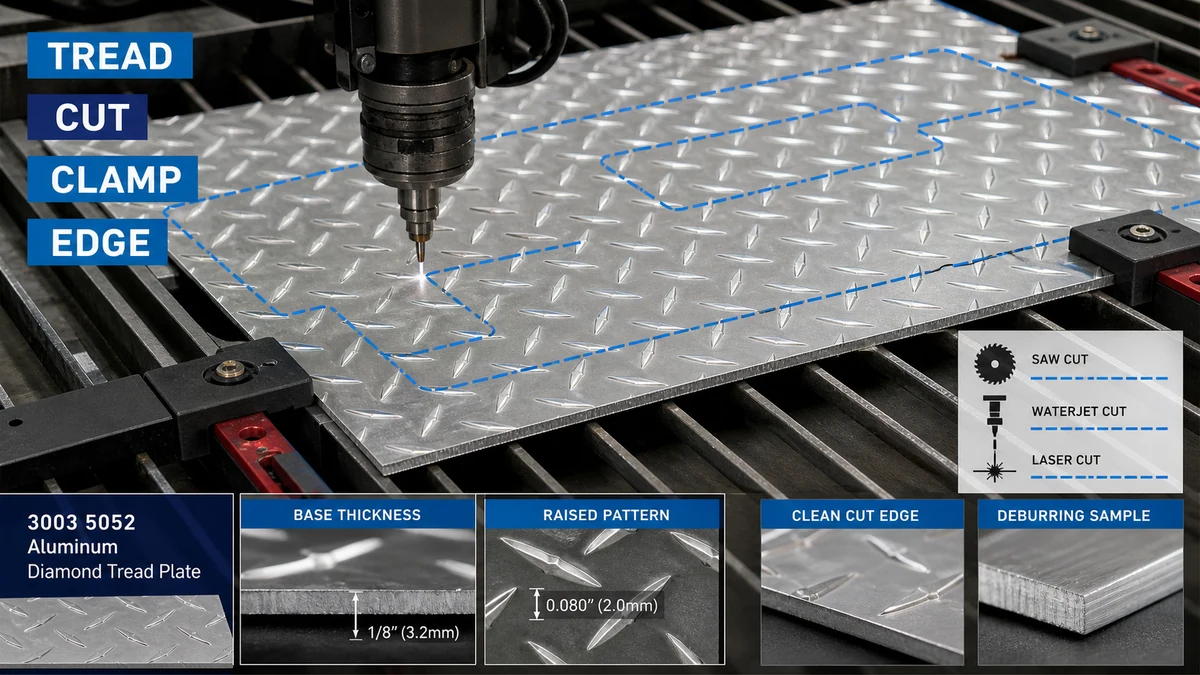
Fabricators should choose the cutting method from the sheet’s base-metal thickness, raised-pattern height, edge tolerance, visible-face requirement, heat sensitivity, and downstream bending. The sheet must be fully supported, clamped through protected contact points, cut with a trial-approved process, and deburred without flattening the tread or damaging the visible surface.
This issue is important for metal fabricators, flooring contractors, toolbox manufacturers, vehicle-body builders, access-platform suppliers, and industrial panel buyers. Before selecting a process, buyers should confirm the material and available configurations through the aluminum sheet product category and the dedicated aluminum diamond tread sheet range.
Why Is Diamond Tread Aluminum Sheet Harder to Cut Than Flat Sheet?
Diamond tread sheet does not present one uniform surface to the cutting tool. The raised pattern creates uneven contact, while the base sheet carries the structural thickness. If machine settings are based on total height instead of base thickness, the fabricator may choose incorrect shear clearance, saw setup, support spacing, or bend allowance.
| Cutting Variable | What Must Be Confirmed | Risk if It Is Ignored |
|---|---|---|
| Base-metal thickness | Thickness measured separately from the raised tread | Incorrect machine capacity, cutting setup, and downstream bend calculations |
| Pattern height and direction | Raised-pattern profile, visible face, and orientation on the finished part | Flattened diamonds, inconsistent appearance, or incorrect panel orientation |
| Edge tolerance | Required cut size, squareness, profile accuracy, and burr acceptance | Parts do not fit during welding, bending, fastening, or assembly |
| Surface condition | Mill finish, decorative face, protective film, and scratch acceptance | Clamp marks, burned film, contamination, or visible handling damage |
| Downstream process | Bending, rolling, welding, coating, fastening, or edge exposure | A cut acceptable as a blank may fail later during forming or finishing |
How Should Fabricators Measure Base Thickness and Pattern Height?
Base thickness and overall pattern height should be recorded separately. The raised diamonds are part of the surface geometry, not a substitute for the nominal base-metal thickness. For procurement, drawings and RFQs should state which thickness value controls acceptance.
A useful receiving check includes:
- Nominal base-metal thickness and permitted tolerance
- Overall sheet dimensions and squareness
- Pattern type, orientation, and visible face
- Flatness and local rocking caused by the raised tread
- Surface scratches, stains, edge damage, and protective-film condition
- Lot or package identification for traceability
When the buyer needs repeated blanks, the drawing should also define whether dimensions are measured from the cut edge, the centerline of the pattern, or another controlled reference. This prevents the supplier and fabricator from using different inspection methods.
Which Cutting Method Fits Straight Cuts, Profiles, and Tight Tolerances?
The correct process depends on part geometry, tolerance, volume, edge quality, heat sensitivity, and available equipment. No single cutting method is automatically best for every diamond tread aluminum sheet.
| Cutting Method | Suitable Use | Main Control Point | Possible Limitation |
|---|---|---|---|
| Saw cutting | Straight shop cuts, repeated rectangular blanks, and common fabrication work | Full sheet support, controlled feed, protected clamping, and trial on the actual alloy and thickness | Vibration, edge burr, surface scratching, or pattern movement if support is poor |
| Shearing | Fast straight cuts where limited edge and pattern deformation is acceptable | Base thickness, clearance, blade condition, and orientation of the visible face | May roll, flatten, or distort the tread near the cut edge |
| Laser cutting | Complex profiles or repeated shapes where process capability and edge requirements justify it | Heat input, protective-film compatibility, edge discoloration, contamination, and trial approval | Thermal effects or film damage may be unacceptable for visible or downstream-finished parts |
| Waterjet cutting | Complex profiles where limiting thermal effects is important | Support, water and abrasive control, edge condition, drying, and post-cut cleaning | Process cost, wet handling, and edge condition must be evaluated for the project |
| Supplier cut-to-size service | Repeated blanks, export projects, and buyers seeking lower internal handling variation | Approved drawing, tolerance, burr direction, visible face, marking, packing, and inspection | Changes after production may require replacement rather than local recutting |
For slip-resistant flooring, steps, platforms, and industrial panels, buyers can review a diamond tread slip-resistant aluminum sheet configuration. Another relevant reference is the aluminium chequered plate option. The exact cutting method should still be approved against the quoted alloy, thickness, pattern, and finished part.
How Should the Sheet Be Supported and Clamped?
Uneven support is a common cause of vibration, chatter, inaccurate cuts, and flattened tread. The raised pattern can make the sheet rock when it rests on a small number of contact points. Support should therefore cover the working area and remain stable throughout cutting.
Good support and clamping practice should include:
- A clean support surface that does not scratch the visible face
- Sufficient support on both sides of the cut to prevent movement or drop-off damage
- Protected clamp contact points that do not crush or polish the raised diamonds
- Clamping positioned away from the final visible area when possible
- Clear identification of the decorative face and pattern direction
- Handling plans for large blanks so the panel does not bend after the cut is completed
Clamping force should hold the material securely without using the tread pattern as an uncontrolled pressure point. For repeated production, the buyer and fabricator should approve a fixture or support arrangement rather than relying on temporary placement for every sheet.
How Can Heat, Burr, and Edge Distortion Be Controlled?
Thermal cutting and mechanical cutting create different risks. Thermal processes can affect protective film, discolor the edge, or introduce local heat distortion. Mechanical processes can create burr, rolled edges, chatter marks, or local flattening of the pattern.
Heat-Control Questions
- Is the protective film approved for the selected cutting process?
- Will the edge remain visible after assembly?
- Will the part be welded, coated, anodized, bonded, or sealed after cutting?
- Does the buyer allow local discoloration or require a visually clean edge?
- How will film residue, contamination, moisture, or abrasive particles be removed?
Burr and Edge-Finishing Questions
- Which side may carry the burr after cutting?
- Is the edge exposed to operators, customers, seals, cables, or other components?
- How much deburring is permitted before the tread appearance changes?
- Must corners be rounded, chamfered, or protected?
- Will edge finishing change the final dimensions or fitting tolerance?
Why Must Pattern Direction Be Planned Before Bending or Assembly?
Pattern direction affects appearance, drainage, grip orientation, panel matching, and fabrication layout. If parts are nested only to maximize material yield, adjacent panels may show different tread directions after installation.
Before cutting, the drawing should identify:
- The visible face
- The required tread direction
- The bending line and bend direction
- Areas where the pattern may be flattened by tooling
- Joint lines between adjacent panels
- Fastener, weld, hinge, and edge positions
Bending should be trialed on the actual material because the raised pattern changes tool contact. The buyer should define whether local pattern flattening near the bend is acceptable and whether the part will be inspected before or after forming.
What Happens in a Typical Industrial Step-Panel Order?
Scenario: Cut and Bent Tread Panels
Business Background: An equipment manufacturer orders diamond tread aluminum sheet for access steps and removable service panels. The parts require straight cuts, several holes, two bends, and a visible mill-finish surface.
Problem: The first batch fits the overall dimensions, but several panels rock during assembly, the tread near the sheared edges is flattened, and clamp marks remain visible after installation. Some bent parts also show inconsistent pattern direction.
Cause: The RFQ listed overall thickness and sheet size but did not distinguish base thickness from pattern height. It also omitted the visible face, burr direction, pattern orientation, clamping protection, flatness after cutting, and acceptable pattern deformation near bends.
Recommended Solution: The buyer updates the drawing to identify base thickness, tread direction, finished dimensions, visible face, cut tolerance, burr side, bend lines, and acceptable local flattening. A representative first article is cut and bent before bulk production. The supplier then packs parts by drawing number and orientation with protected separators.
Buyer Decision Value: The added drawing and first-article control reduce sorting, rework, incorrect installation, and surface rejection. The correct comparison is the cost per accepted fabricated panel, not only the price per sheet.
When Is Buying Cut-to-Size Material Better Than Cutting Full Sheets?
Buying full sheets may be suitable when the fabricator has stable equipment, flexible nesting requirements, and sufficient handling capacity. Cut-to-size supply may be more economical when the same blanks repeat, the surface is highly visible, or export handling creates a high risk of scratches and dimensional variation.
| Supply Option | Main Advantage | Main Risk | Best Fit |
|---|---|---|---|
| Full sheets | Maximum flexibility for nesting and design changes | More internal handling, cutting setup, scrap control, and surface risk | Fabricators with established cutting and inspection capability |
| Rectangular cut-to-size blanks | Reduced handling and repeatable blank dimensions | Drawing mistakes affect the full batch | Repeated panels, steps, covers, and toolbox components |
| Profile-cut first articles and production parts | Lower internal process variation and clearer supplier responsibility | Requires complete drawings, approval records, and change control | Complex profiles, visible parts, and project-controlled assemblies |
What Should a Diamond Tread Aluminum Sheet RFQ Include?
A complete RFQ should allow suppliers to quote the same material, cutting scope, inspection, and packing requirements. Buyers should provide:
- Application, finished-part drawing, revision number, and quantity
- Alloy and temper requirement, or a request for the supplier to propose an option
- Base-metal thickness, sheet size, tread pattern, and pattern orientation
- Visible face, protective-film requirement, and acceptable surface condition
- Cutting method if fixed by the buyer, or performance requirements if the supplier may propose the process
- Finished dimensions, tolerances, squareness, profile accuracy, and hole requirements
- Burr direction, edge finish, corner treatment, and exposed-edge requirements
- Bend lines, bend direction, acceptable pattern flattening, and downstream welding or coating
- First-article quantity, inspection method, sampling, records, and nonconformance process
- Piece marking, drawing number, orientation marks, interleaving, pallet limits, destination, and Incoterm
- MOQ, forecast, delivery target, and whether partial shipments are allowed
Frequently Asked Questions
Should diamond tread sheet thickness include the raised pattern?
The RFQ should distinguish base-metal thickness from overall pattern height. Machine setup, strength calculations, bend planning, and acceptance can be incorrect when the two values are treated as the same measurement.
Can diamond tread aluminum sheet be cut with a saw?
Yes, saw cutting can suit straight fabrication cuts when the actual alloy and thickness are trialed. Stable support, protected clamping, controlled feed, surface protection, and burr inspection are essential.
Does shearing damage the diamond pattern?
Shearing can deform or flatten the pattern near the cut edge. Whether that is acceptable depends on the visible-face requirement, edge exposure, tolerance, and downstream forming. A representative trial should be approved.
Can protective film remain on the sheet during cutting?
Only when the film is confirmed as suitable for the selected process. Unknown film may burn, contaminate the edge, trap moisture, create residue, or produce unacceptable surface damage.
When should waterjet or laser cutting be considered?
They may be considered for complex profiles or tighter process requirements. The buyer should compare heat sensitivity, edge condition, tolerance, cleaning, film compatibility, volume, and total cost using the actual material.
Does burr direction matter?
Yes. Burr direction matters when the edge is visible, handled by operators, fitted against another component, coated, sealed, or bent. The drawing should identify the permitted burr side and finishing requirement.
When is a first article necessary?
A first article is valuable for new drawings, tight tolerances, visible surfaces, complex profiles, secondary bending, protected-film requirements, or repeated production where one setup will be used for the full order.
Request a Cut-to-Size Tread Sheet Review
For a project-specific review, provide the alloy and temper, base thickness, sheet size, tread pattern, finished drawing, visible face, cutting tolerance, burr direction, bending requirements, quantity, inspection, packing, destination, and delivery schedule through the TOP METAL quotation and technical review page. The supplier can then review material availability, cut-to-size feasibility, sample requirements, processing scope, inspection, export packing, MOQ, lead time, and quotation exclusions before production.
Request a diamond tread aluminum sheet quotation with the alloy, temper, base thickness, tread pattern, finished drawing, cutting tolerance, visible face, bending, inspection, packing and delivery details required for a comparable offer.