
How to Qualify an Aluminum Sheet Metal Supplier in China: A Factory Audit Checklist for Overseas Buyers
If you’re sourcing aluminum sheet metal from China for the first time, the hard part usually isn’t finding suppliers. It’s knowing which ones can hold your spec once the order ships. The short answer: lock your alloy, temper, gauge, and finish first, then compare quotes on that same spec, verify claims with documents instead of promises, audit the factory’s process, and inspect a production sample before it leaves the country. This guide walks through that checklist step by step, starting with the tools, budget, and time you’ll need, then covering spec normalization, sourcing channels, alloy and temper selection, forming tests, evidence requests, the factory audit, and pre-shipment inspection.
Prerequisites: Tools, Budget, and Time You Need
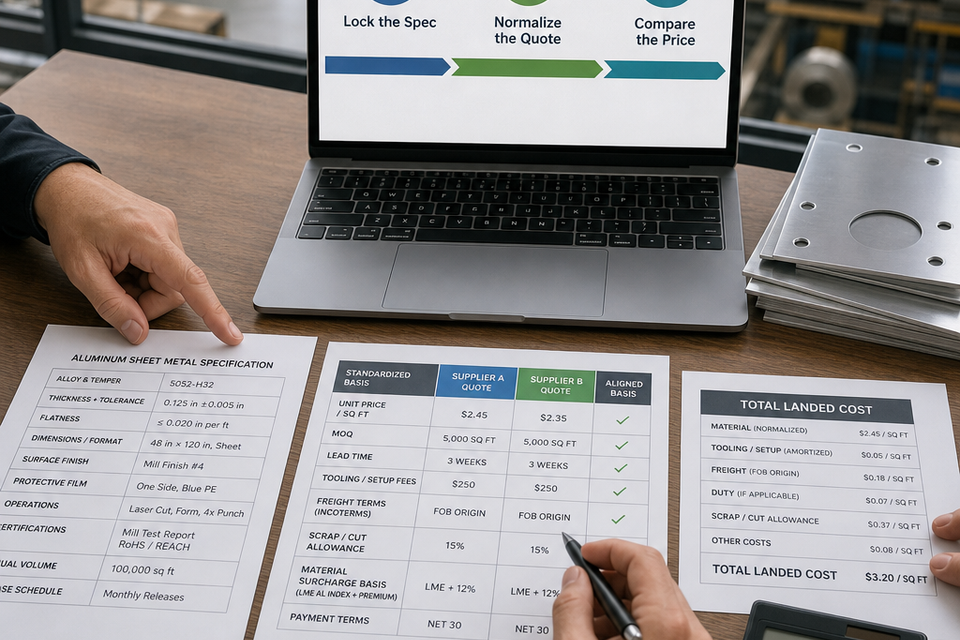
Illustration for Prerequisites: Tools, Budget, and Time You Need
Before you contact any China aluminum sheet manufacturer, lock your spec, gather four tools, and plan for two to four weeks and a few hundred dollars per inspection visit.
Step 1: Lock the spec.
- What: Write down the end use, alloy and temper (for example, 5052-H32 for a bent enclosure), thickness range, finish, and quantity.
- Why: Suppliers quote only what you define. Vague specs produce low quotes that rise later.
- How: Put these five items in one shared document and send the same version to every supplier.
Step 2: Gather your tools.
- A caliper or micrometer to check thickness against your tolerance.
- A digital camera for surface, finish, and mill-mark photos.
- A shared spreadsheet to log quotes by alloy, temper, gauge, and finish.
- A copy of ASTM B209 (US) or EN 485/EN 573 (Europe) to confirm chemistry and temper designations.
Step 3: Budget for inspection and samples. Third-party inspection typically costs a few hundred dollars per visit, and the rate varies by region. Add sample shipping, and budget for at least one full sample round.
Step 4: Plan the time. Full qualification of a new supplier usually takes two to four weeks. That covers evidence requests, sample testing, and follow-up questions.
Normalize quotes before you compare prices. The lowest unit price often signals the weakest qualification. Alloy verification gaps, temper inconsistency, and cut-to-size fees tend to surface after you place the order. A quote that looks cheaper per sheet may exclude cut fees or skip the mill certificate. Compare quotes only when alloy, temper, gauge, finish, sheet size, and cut fees match.
Run the audit checklist first.
- Does the mill certificate match the alloy and temper you requested?
- Do sample thicknesses stay within your tolerance across the batch?
- Does a bend test on samples match your forming needs?
- Is the cut-to-size fee schedule in writing?
Only suppliers that pass these checks deserve a price comparison.
Once your spec is locked, request an aluminum sheet quote with the same details for every supplier.
Step 1: Lock the Spec and Normalize Quotes Before Comparing Prices
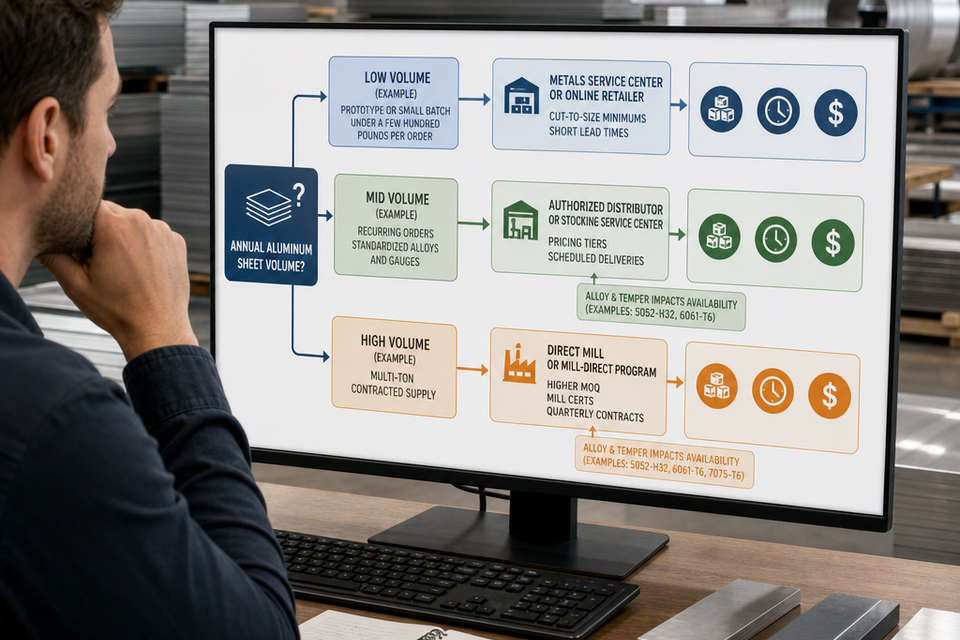
Illustration for Step 1: Lock the Spec and Normalize Quotes Before Comparing Prices
Write one spec sheet, send it to every supplier, and compare only quotes that match it line by line. A low price on a different product is not a better price.
Step 1: Write the spec sheet (about 30 minutes)
- What: Record the alloy by designation and temper, such as 5052-H32, not “same as 5052.” Add gauge in both mm and inches, the tolerance basis, sheet size, surface finish, and cut-to-size requirements.
- Why: Temper changes strength and formability. Finish changes cost and whether the sheet is ready for anodizing. Suppliers fill gaps with their own defaults, so the quotes end up describing different parts.
- How: Use one table with a row for each field. Keep it to one page. Link to the aluminum sheet products range if you need to match a grade to your application.
Step 2: Send the same RFQ to every supplier
Attach the spec sheet and add this line: “No substitutions without written approval.” Ask each supplier to quote against that sheet only. If they propose an alternative, make them quote it as a separate line.
Step 3: Normalize the quotes
Put the responses side by side. Check these fields first:
- Alloy and temper
- Gauge basis (mm or inches, and tolerance)
- Finish (mill, painted, or anodize-ready)
- Cut-to-size fees
- Price per square foot
Price per square foot matters for sheet size. A 4’x8′ sheet is 32 square feet, so a per-sheet price means little until you divide it by the sheet size on every quote.
Step 4: Sort every claim into documented or verbal
Some suppliers will say “our material meets spec.” Treat that as a claim until you receive a document. Request:
- Alloy and temper: Mill test certificate (MTC) for the lot, with chemistry and temper listed.
- Thickness tolerance: Measurement report from the lot, taken at several points on each sheet, not one corner.
- Surface finish: A sample sheet, plus the standard the supplier uses to define the finish.
- Pre-shipment inspection: A written protocol and the inspection record for your order.
Log each item in a sheet with these columns: claim, source, document reference, status (documented or verbal), acceptance limit, result, and pass or fail.
Set acceptance limits yourself. Pull them from the standard your spec cites, such as ASTM B209 or EN 485/EN 573, and confirm which edition applies. This guide does not list benchmark values.
Common mistakes
- Accepting “same as 5052” without a temper.
- Comparing a mill-finish quote against an anodize-ready quote.
- Counting a verbal confirmation as proof.
**Pro tip:**Treat an incomplete quote as incomplete, not cheaper. Ask for the missing field before you compare prices.Ask for the MTC before you place an order. Asking after shipment leaves you little leverage.Use the 5052 aluminum sheet page to check your alloy and temper choice before you write the sheet.
When the spec and the documents match, send your sheet through the quote request form.
Step 2: Choose the Sourcing Channel That Fits Your Volume
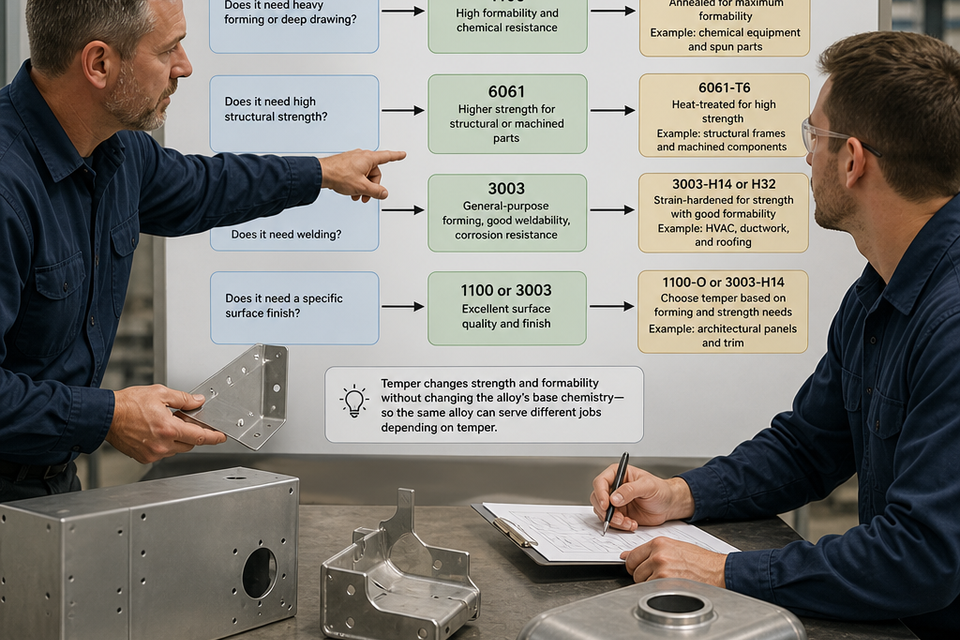
Illustration for Step 2: Choose the Sourcing Channel That Fits Your Volume
Match your order size to one of four channels before you request a quote. Mill-direct works for large, repeat orders. Metals service centers and remnant stock work better for prototypes and small runs. Online distributors and local suppliers cover the middle ground.
| Channel | Best for | Minimum order | Cut-to-size | Remnants |
|---|---|---|---|---|
| Mill-direct | Large, repeat orders | Highest, usually full-mill lots | Rarely offered | Rarely offered |
| Metals service center | Small to mid runs | Lower, often by the sheet | Usually offered | Often available |
| Online catalog distributor | Single sheets, fast quotes | Low, but check per listing | Varies by listing | Varies |
| Local supplier | Urgent or local pickup | Low | Usually offered | Sometimes available |
Confirm each channel’s terms on the phone or in writing. Policies vary by supplier.
Steps to choose your channel:
- Calculate your need. A 4’x8′ sheet covers 32 square feet. Count the sheets and the cut parts you need.
- Match the volume. Use mill-direct only when you order full lots again and again.
- Ask for remnants first. Community buyers on CNC and metalworking forums often report that remnant stock is the cheapest route for prototypes.
Common mistakes:
- Assuming mill-direct is cheaper at low volume. The minimum order often forces you to buy far more than you need.
- Ignoring freight. A full sheet ships as a bulky, heavy item, and freight can rival the material cost on small orders.
Illustrative scenario: A hypothetical buyer needs 5052 sheet for 40 outdoor enclosures and sources from a Chinese manufacturer. The RFQ lists ASTM B209 5052-H32. The buyer maps it to the EN designation (EN AW-5052, H32) so the supplier’s documents match the European partner’s drawings. During audit, the mill certificate shows H34, a temper mismatch. The checklist catches it before production, which avoids reworking a full batch of bent panels.
For the full spec, see the 5052 aluminum sheet page. For a sourcing quote, use the request an aluminum sheet quote form, and list your ASTM and EN specs together.
Step 3: Match Alloy and Temper to the Application
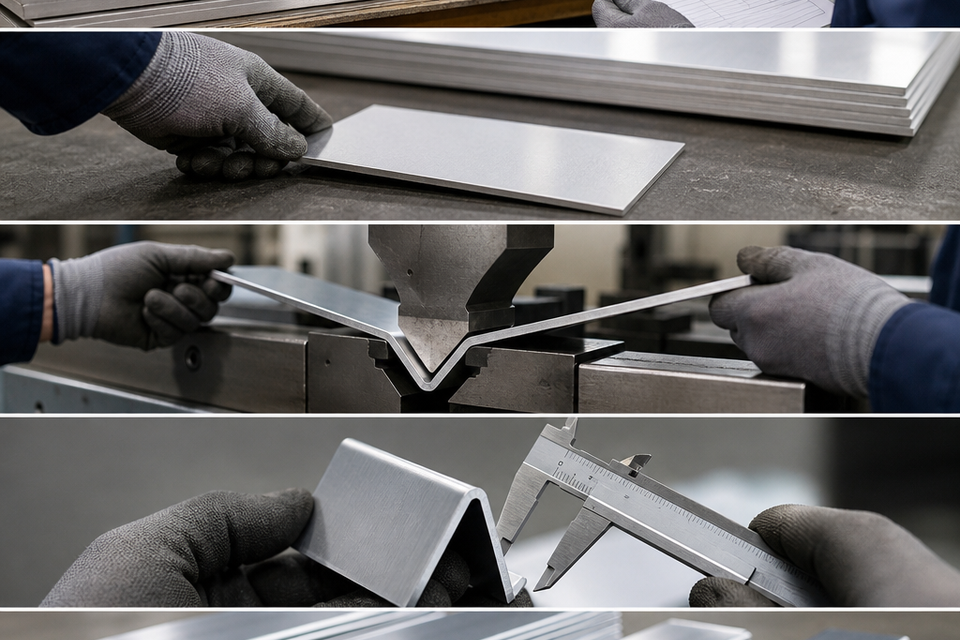
Illustration for Step 3: Match Alloy and Temper to the Application
Pick alloy and temper by end use, not by the first grade on a supplier’s list. Each application stresses a different property, and one grade rarely wins on all of them.
Why it matters: Enclosures need stiffness and clean fabrication. Marine and outdoor parts need corrosion resistance. Cosmetic anodized faces need a consistent finish. Forming-heavy parts need ductility.
| Application | Starting point | Anodizing note | Forming note |
|---|---|---|---|
| Outdoor enclosure or marine | 5052-H32 | Anodizes well, but shade can vary by lot | Good formability |
| Cosmetic anodized face | 6061-T6 | Test panels confirm the finish | Poor for tight bends |
| Tight-bend formed part | 5052-O or 3003-O | Check color on a test panel | Soft temper bends cleanly |
How to do it:
- Define exposure and finish. Note whether the part sees salt, weather, or a visible anodized surface.
- Pick a starting alloy and temper from the table. For outdoor and marine work, start with the 5052 aluminum sheet spec basis.
- Confirm the bend radius. Ask the supplier whether your temper holds your radius at your thickness.
- Run a spec-language check on the RFQ. Confirm “sheet” (not plate or foil), thickness in mm, alloy, and temper match in both your RFQ and the supplier’s quote. Writing 1/8 in when you mean 3 mm creates a 0.175 mm gap before anyone measures a part.
Common mistakes:
- Choosing 6061-T6 for heavy forming. It cracks on tight bends.
- Assuming all alloys anodize with the same look.
Pro tip: Request anodize test panels before approving production when appearance matters.
Time: About one hour per part family.
When your alloy, temper, and mm thickness are set, send them through the request an aluminum sheet quote page.
Step 4: Verify Forming Capability Before You Commit

Illustration for Step 4: Verify Forming Capability Before You Commit
Before you approve production, bend a test sample at your tightest radius. Whether a factory is “reliable” matters less than which failure modes its process controls for your part. For forming-heavy parts, those failures are cracking and springback.
Step 1: Check the spec language first
- What: Ask the supplier to restate your order in writing: alloy, temper, thickness in mm, and product form (sheet, plate, or foil).
- Why: Gauge, sheet versus plate, and mm versus inch cause many RFQ errors. A drawing that reads “0.5” can turn into 0.5 inch (12.7 mm) on one side of the deal.
- How: Compare the supplier’s restatement line by line with your drawing. Fix mismatches before any material is cut.
Step 2: Get the minimum bend radius table
- What: Request the supplier’s minimum bend radius guidance for your exact alloy, temper, and gauge.
- Why: Cracking and springback drive most rework, especially at thin gauges like 0.5 mm.
- How: Check that the table matches your alloy and temper, not just the alloy family.
Step 3: Run a bend test on sample coupons
- What: Bend coupons at your target radius, starting with the tightest one.
- Why: Thin gauges tolerate tight radii poorly, so the tightest test fails first and costs the least.
- How: Bend coupons both across and along the grain. Inspect the bend zone under magnification or with dye penetrant. Measure the angle after release, then adjust the die for springback.
Common mistakes
- Testing only across the grain on the first pass.
- Setting the die to the drawing angle and ignoring springback.
Time and effort: Plan roughly half a day for a basic coupon set, including inspection and die adjustment.
If your part needs heavy forming, compare alloy options on the 5052 aluminum sheet page, then request an aluminum sheet quote with your drawing and bend radius attached.
Step 5: Request Documented Evidence and Sort Every Claim
Before you place an order, request three things: mill test certificates (MTCs), sample sheets, and process records. Then sort every supplier statement into “documented” or “asserted verbally.” Only documented claims give you something to check after the goods ship.
Ask which failure modes the factory controls. Don’t ask only “is this factory reliable?” Ask which failure modes its process controls for your part. A shop with tight thickness control can still ship the wrong temper. Each claim should map to one failure mode you care about.
Check the spec language before production. Many sourcing errors start at the RFQ. Gauge, sheet, plate, and foil get used loosely, and aluminum gauge numbers do not match steel gauge numbers. Plate generally starts around 6 mm (0.250 in). Mixing units causes real damage: a 0.125 in sheet is 3.18 mm, and a supplier who reads “0.125” as millimeters ships material about 25 times thinner. Send a one-page spec and ask the supplier to restate it: alloy, temper, thickness in mm and inches, tolerance standard, and finish.
Request evidence for each claim:
- Alloy and chemistry: Check the MTC for alloy designation, chemical composition, and a heat or lot number.
- Temper: Confirm the temper designation on the same document. Ask for mechanical test results if forming matters.
- Thickness: Ask for measured values against the cited standard, such as ASTM B209. A “within tolerance” statement alone does not count.
- Surface finish: Ask for the finish standard and a sample from the production lot, not a showroom piece.
Build an evidence log:
| Claim | Evidence requested | Document received | Status |
|---|---|---|---|
| 6061-T6 supplied | MTC with heat number | Yes | Documented |
| Thickness within tolerance | Measurement report to ASTM B209 | No | Asserted verbally |
| Mill finish | Finish standard and sample | Pending sample | Asserted verbally |
Common mistakes:
- Accepting a generic certificate with no heat or lot number.
- Accepting a certificate you cannot trace to the shipped bundle.
- Treating a verbal “we always do that” as evidence.
Pro tip: Ask for traceability from MTC heat numbers to the shipping marks on each bundle. Request a photo of the stencil or label. This link is the only thing that connects paperwork to your metal.
Effort and cost: Building the spec sheet and log takes a few hours. Sample sheets and third-party testing may add cost, so confirm who pays before you approve them. Also confirm the certificate matches the bundle date, because suppliers sometimes send a certificate from a different lot.
Once your log is complete, send it with your request an aluminum sheet quote. For alloy options, compare aluminum sheet products and 5052 aluminum sheet.
Step 6: Run the Factory Audit Checklist
Audit the factory against the failure modes that could hurt your part, not against a general tour. Start with the RFQ. Many sourcing errors begin there, and a factory audit can’t fix a spec that buyer and supplier read differently.
Step 1: Check the spec language before production
- What: Confirm that both sides mean the same product, in writing, before any sheet is cut.
- Why: Three terms cause most mix-ups:Gauge. Aluminum gauge numbers don’t match steel gauge. Specify thickness in mm instead.Sheet vs. plate vs. foil. Under ASTM B209, plate starts at 0.250 in (6.35 mm). A supplier who reads “sheet” as “plate” will quote and machine differently.mm vs. inch. One inch equals 25.4 mm. A 0.125 in part is 3.175 mm, so a drawing that says 3.0 mm is 0.175 mm thinner.
- How: Send a one-page spec sheet with alloy, temper, thickness in mm with tolerance, sheet size in mm, finish, and cut-to-size requirements. Ask the supplier to restate it in their own words. Any gap shows up here, at no cost.
Step 2: Walk the physical flow
- What: Ask for a walk-through from incoming coil or stock to shipping. Check that the records match what you see on the floor.
- Why: A showroom or sample line proves one good run. Your production needs the same result every time.
- How: Work through the checklist below. Mark each item:Pass: Records and the physical process match.Fail: Records are missing or contradict what you see.Asserted only: The supplier states it but shows no record.
| Checklist item | Pass | Fail | Asserted only |
|---|---|---|---|
| Quality management documentation on file | Current, controlled documents | Missing or outdated | Verbal claim only |
| Raw material traceability | Heat or lot numbers link coil to order | No link to incoming material | Assumed |
| Incoming alloy verification | Mill cert checked against stock | No check logged | Cert only, no check |
| Temper control | Temper recorded per batch | Temper not tracked | Stated, not logged |
| Cut-to-size equipment and tolerance records | Measurements logged against tolerance | No measurement log | Equipment shown, no data |
| Export packaging | Method documented for sea freight | Packing is ad hoc | Described only |
| Export documentation experience | Recent export shipments with paperwork | No export history | Claimed |
Pro tip: For every test certificate, check whether the testing lab holds accreditation, such as ISO/IEC 17025. An accredited lab’s certificate carries more weight than a certificate from an unknown lab.
Common mistakes to avoid
- Auditing only the showroom or sample line.
- Accepting a certificate without checking the lab.
- Treating “asserted only” as a pass.
Time and cost
A remote review of documents and a video walk-through usually takes a few hours. An on-site audit takes a day or more. Budget for it, because it costs less than scrapping a production run.
Pricing context
Quotes depend on alloy, temper, gauge, sheet size, finish, and cut-to-size fees. A 4’x8′ sheet is about 2.97 m². Ask the supplier to price the full sheet and the cut fee separately, so you see which charge drives the total.
Ready to test your spec with a supplier? Request an aluminum sheet quote and include your spec sheet, or browse aluminum sheet products to compare options first.
Step 7: Run Pre-Shipment Inspection and Log Acceptance
Run the inspection on a sample from the finished lot before it ships. Measure against thresholds you set in advance, and log every result. You can still fix, reject, or hold a lot at this stage. After the container is loaded, you can’t.
The inspection only works if the supplier and buyer describe the same product. Many disputes start at the RFQ, where “gauge,” “thickness,” “sheet,” and “plate” get used loosely, and mm and inch get mixed on the same drawing. Before production, check that your spec and the supplier’s quote match on thickness in mm, alloy and temper, and the cited standard. Ask the supplier to restate the spec in their own words.
Steps
- Set acceptance thresholds first. Base them on your drawing, your application, and the cited standard. Verify every value against the current standard. Don’t copy numbers from a blog.
- Measure thickness at several points. Check corners, center, and edges on multiple sheets, not just the top one.
- Check flatness on a reference surface. Record the maximum gap.
- Inspect the surface under bright, angled light. Note scratches, staining, and handling marks.
- Confirm the MTC. Match its heat or lot number to the markings on the sheets.
- Log and photograph everything. Record each reading, its pass or fail status, and a photo of any defect.
Common mistakes
- Inspecting only the top sheet. Defects often sit lower in the stack.
- Setting thresholds after you see the results. That turns the log into a justification, not a check.
Pro tip: Attach the completed log to the PO. It becomes your evidence if you need a credit or replacement.
Plan a few hours per standard lot, depending on count. That’s far cheaper than returning a shipment. If your spec still has loose terms, request an aluminum sheet quote and confirm the details before production starts.
Common Qualification Mistakes Buyers Report in Community Forums
Most forum-reported sourcing failures start at the RFQ, not on the factory floor. Before you judge whether a supplier is reliable, confirm that you and the supplier describe the same product. Ask which failure modes their process controls for your application, then check the spec language.
Threads on CNC and metalworking boards often describe the same problem: a buyer asks for “16 gauge” aluminum and receives sheet that doesn’t fit. Aluminum gauge does not match steel gauge. 16 gauge is about 0.051 in (1.29 mm) for aluminum but about 0.060 in for steel.
Step 1: Write thickness in millimeters, with tolerance (about 10 minutes).
- What: Replace gauge numbers with a metric thickness and a tolerance, such as “1.30 mm ±0.05 mm.”
- Why: Gauge charts differ by metal, and each supplier may use a different one.
- How: Put the thickness in the RFQ and ask the supplier to repeat it back.
Step 2: Name the product form (about 5 minutes).
- What: Specify sheet, plate, or foil.
- Why: Plate is generally 6 mm and thicker, and foil is much thinner than sheet. Each form may follow a different process and price.
- How: Write the form next to the thickness, not in a separate note.
Step 3: Convert and confirm dimensions (about 10 minutes).
- What: Write sizes in one unit system. A 4’x8′ sheet is about 1219 x 2438 mm.
- Why: Mixed inch and mm dimensions cause cut-to-size errors.
- How: Show both units once, then list the metric size as the controlling spec.
Step 4: Require a read-back (about 15 minutes).
- What: Ask the supplier to restate alloy, temper, thickness, size, and finish in their own words.
- Why: A mismatch here costs less to fix than a rejected shipment.
- How: For example, confirm “5052-H32, 1.30 mm, 1219 x 2438 mm, mill finish.” If any item differs, stop and correct it.
Common mistakes to avoid:
- Accepting “same as last order” without re-checking the spec.
- Treating a supplier’s email summary as confirmation.
- Skipping temper, which changes forming behavior.
Pro tip: Send a one-page spec sheet with every RFQ. Compare the supplier’s reply line by line. Suppliers from China that handle export regularly usually can restate specs quickly. Hesitation is a signal to dig deeper.
Ready to test your spec sheet? Review aluminum sheet products, check 5052 aluminum sheet, or request an aluminum sheet quote.