
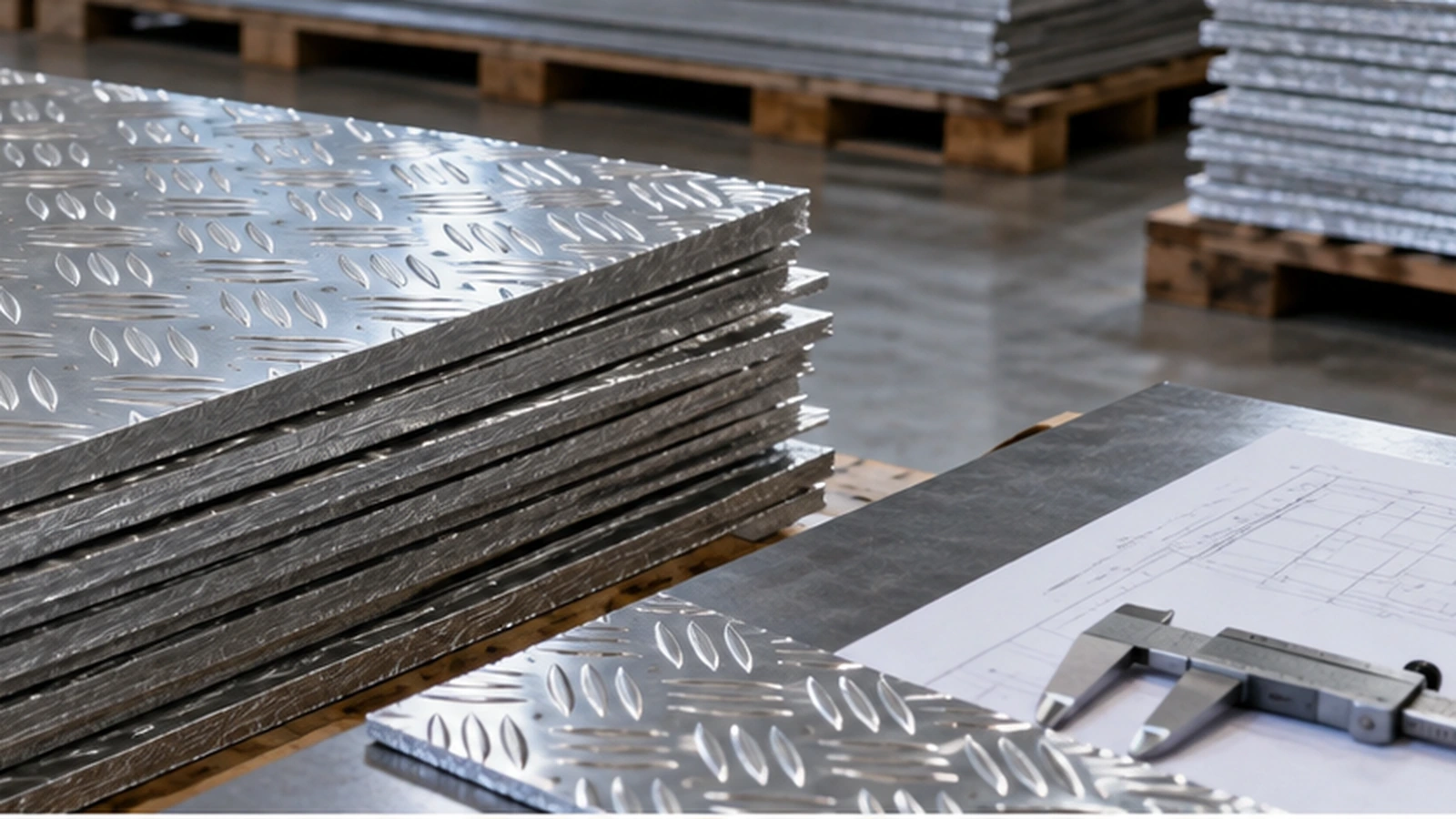
A 4x8 sheet of 1/4 inch aluminum price quotation becomes useful only after the buyer confirms that every supplier is pricing the same product and delivery scope. For this procurement path, the target product is a 1/4-inch 5052 aluminum tread plate rather than a generic flat aluminum sheet. Price differences can come from base-metal thickness, actual sheet size, temper, tread pattern, quantity, unit or weight basis, cutting and fabrication, surface protection, inspection documents, packing, delivery term and quotation validity. The objective is therefore not to find a universal price per sheet. It is to normalize the technical and commercial assumptions first, identify what each supplier has included or excluded, and then compare quotations on a like-for-like basis.
First Confirm That Every Supplier Is Quoting the Same Product
The phrase “4x8 sheet of 1/4 inch aluminum” does not define one commercial product. One supplier may interpret it as a flat sheet, while another may quote a diamond, five-bar or other raised-pattern tread plate. Suppliers may also use different alloys, tempers or thickness definitions.
For this project, the quotation should clearly identify 5052 aluminum tread plate as the required product form. Buyers can use TOP METAL's Aluminum Checkered Plate Tread category to confirm the relevant product family before issuing the RFQ.
This first step matters commercially because a lower price for plain sheet is not a lower price for an equivalent tread plate. The quotation line should therefore state the alloy, product form, nominal dimensions and required tread pattern before price comparison begins.
Base-Metal Thickness Has a Direct Effect on Material and Freight Cost
For tread plate, “1/4 inch” needs a defined measurement basis. The buyer should state whether the requirement refers to the base-metal thickness rather than an overall measurement across the raised pattern.
This is one of the most important price variables because a thicker base contains more aluminum per sheet. More metal changes material consumption, sheet weight and freight weight. Two products may look visually similar while using different base thicknesses and therefore different amounts of aluminum.
A supplier quoting a thinner base with a raised pattern should not be compared directly with a supplier quoting a true 1/4-inch base-metal requirement. The RFQ should require each supplier to repeat the thickness basis in its quotation so the buyer can see whether the price difference comes from the material specification rather than supplier margin.
Exact Sheet Dimensions Change Yield and Weight per Piece
“4x8” commonly refers to a 48 × 96 inch sheet, but B2B suppliers may work from different stock sizes, metric equivalents or larger mother plates that are cut to size.
If the project needs finished 48 × 96 inch sheets, state that exact finished dimension. If a close metric stock size is acceptable, identify the permitted alternative. When the material will be cut into smaller parts, providing the finished part sizes or nesting plan may allow the supplier to quote a more efficient material route.
The commercial effect is straightforward: sheet dimensions influence total material weight, cutting yield, trimming loss and packing. A lower per-sheet number is not necessarily a better offer if the finished dimensions or usable material area are different.
Temper and Pattern Can Create Different Quotation Bases
Two quotations that both say “5052 tread plate” may still describe different products if the temper or tread pattern is not the same.
Temper should be defined by the buyer's fabrication requirement or returned by the supplier as a clearly stated proposal for approval. A forming operation, bending requirement or direct-use panel may require different material conditions. The quotation should therefore show the exact temper offered rather than leave the designation incomplete.
The tread pattern should also be identified. Diamond, five-bar and other raised patterns should not be treated as automatically interchangeable when the project drawing, sample or end-use appearance requires a particular form.
The important price question is not whether one temper or pattern is universally more expensive. It is whether all suppliers are quoting the same approved temper and pattern. Only after those fields are aligned does the commercial comparison become meaningful.
Quantity Changes the Production, Packing and Freight Basis
Quantity affects more than a simple volume discount. A small trial order may be cut from available material, while a larger order may use a different production, packing or shipment arrangement.
The buyer should state:
- Total number of sheets or total required weight
- Whether the quantity is a trial, one-time project or repeat requirement
- Whether delivery will occur in one shipment or multiple releases
- The unit in which the supplier should quote
Per-sheet prices are especially difficult to compare when suppliers use different sheet weights or thickness assumptions. Where useful, ask the supplier to state the sheet weight or the weight basis used for the commercial calculation. This makes it easier to identify whether a price difference is caused by material quantity rather than the supplier's unit price.
Processing Scope Can Create a Large Difference Between Two Prices
A full sheet and a finished fabricated panel are not equivalent commercial products.
Depending on the project, the supplier may be asked to provide:
- Full 4x8 sheets
- Cut-to-size panels
- Holes or slots
- Corner notches
- Bends or formed edges
- Edge finishing
- Other drawing-based processing
TOP METAL's company scope includes custom aluminum processing, but the exact work included in an individual quotation must still be confirmed for the specific order. A quote for raw sheets should not be compared directly with a quote that includes cutting, drilling or forming.
The buyer should therefore place processing requirements directly on the RFQ and attach the current drawing revision where applicable. Each supplier should return the included processing scope and identify any excluded or optional operation.
Surface Protection and Packing Affect the Delivered Cost
The delivered value of patterned aluminum can also change with surface-protection and packing requirements.
If the visible face needs protective film, interleaving, edge protection or another handling measure, state that requirement before pricing. The same applies to pallet configuration, package weight limits, labels or export-protection requirements.
A few sheets collected locally and a bulk export shipment do not need the same packing scope. The buyer should therefore ask each supplier to describe what is included instead of assuming that all quotations contain equivalent packaging.
A lower material price can lose its advantage if protective packing, pallet preparation or export handling is later added as a separate cost.
Inspection and Documentation Should Be Priced as Part of the Scope
Different projects require different evidence. Some buyers need standard commercial documentation only, while others require material certificates, dimensional inspection, traceability, third-party inspection or project-specific acceptance records.
If the project requires ASTM B209 or another material standard, identify that requirement in the RFQ and ask the supplier to confirm the governing basis for the quoted product. Do not assume that a general product description automatically satisfies a project-specific standard.
Documentation should also be connected to the actual material being supplied. If the buyer requests a material certificate, inspection report or traceability record, the quotation should state whether that document is included and what production lot or shipment it covers.
This creates a clearer price comparison because one supplier may include inspection and documentation that another has excluded.
Delivery Basis and Quotation Validity Can Change the Final Commercial Number
Material prices should not be compared before the delivery basis is aligned.
A quotation may be based on EXW, FOB, CFR, CIF or another agreed term. Depending on the offer, the price may or may not include export packing, inland transport, port charges, ocean freight or insurance.
The buyer should ask each supplier to state:
- Currency
- Quotation unit
- Incoterm or delivery basis
- Destination
- Quotation validity
- Freight and packing inclusions
When these commercial fields are different, a direct unit-price comparison can produce the wrong sourcing decision.
Use the 1/4″ 5052 Aluminum Tread Plate Page as the Product Reference
TOP METAL's 1/4″ 5052 aluminum tread plate page establishes the intended product direction for this quotation path.
The page should be treated as the product reference rather than a complete project specification. The buyer still needs to define the exact temper, base-thickness basis, finished 4x8 dimensions, tread pattern, quantity, processing, surface protection, inspection documents, packing and commercial delivery terms for the order being quoted.
Normalize These Inputs Before Comparing Suppliers
| Quotation Variable | Buyer Must Define | Why It Changes the Price |
|---|---|---|
| Product form | 5052 tread/checkered plate rather than generic flat sheet | Different product forms use different material and production routes |
| Thickness basis | Whether 1/4 inch refers to base-metal thickness | Changes material weight, consumption and freight basis |
| Sheet dimensions | Exact 48 × 96 inch size or accepted alternative | Changes material weight, cutting yield and packing |
| Temper | Required condition or supplier proposal for approval | Different material conditions are not technically identical |
| Tread pattern | Required pattern family and orientation where relevant | Changes product configuration and availability |
| Quantity | Total sheets or weight and shipment plan | Changes production, handling and freight basis |
| Processing | Raw sheet, cut-to-size, holes, bends or other fabrication | Adds manufacturing, setup and inspection scope |
| Surface protection | Visible face, film, interleaving or protection requirements | Adds material and handling scope |
| Documentation | Certificates, inspection, traceability or third-party requirements | Adds quality-control and documentation work |
| Packing | Pallet, edge protection, moisture protection and labels | Changes export and transport preparation cost |
| Commercial basis | Currency, unit, Incoterm, destination and validity | Separates material price from logistics and commercial scope |
Only after these variables are aligned should the buyer compare the final commercial number. Otherwise, a lower quotation may simply describe a different sheet or a narrower delivery scope.
Where Does This Price Logic Change?
This quotation framework applies when the actual requirement is a 4x8, 1/4-inch 5052 aluminum tread plate.
The comparison must be reopened if the project changes to:
- Flat 5052 sheet instead of tread plate
- A different aluminum alloy
- A different base-metal thickness
- Another tread pattern
- Coil instead of sheet
- Anodized or coated material
- A fully fabricated component instead of raw plate
If alloy or thickness is controlled by engineering requirements, procurement should not change those fields solely to obtain a lower unit price. The approved technical specification remains the comparison baseline.
Prepare a Comparable RFQ Before Asking for the Final Price
A useful RFQ should state the 5052 alloy, required temper, tread pattern, base-thickness basis, finished 4x8 dimensions, quantity, application, required processing, visible-side condition, protective film, inspection documents, packing, destination and commercial delivery basis.
Ask each supplier to return:
- The exact offered specification
- The quotation unit and weight basis
- Included processing
- Included surface protection
- Inspection and document scope
- Packing configuration
- Delivery basis
- Quotation validity
- Every deviation or alternative
Once the scope is normalized, submit the project through TOP METAL's Request Quote page. The objective is not to find one universal 4x8 sheet of 1/4 inch aluminum price. It is to obtain quotations that describe the same 5052 tread plate, the same processing scope and the same delivery basis.