
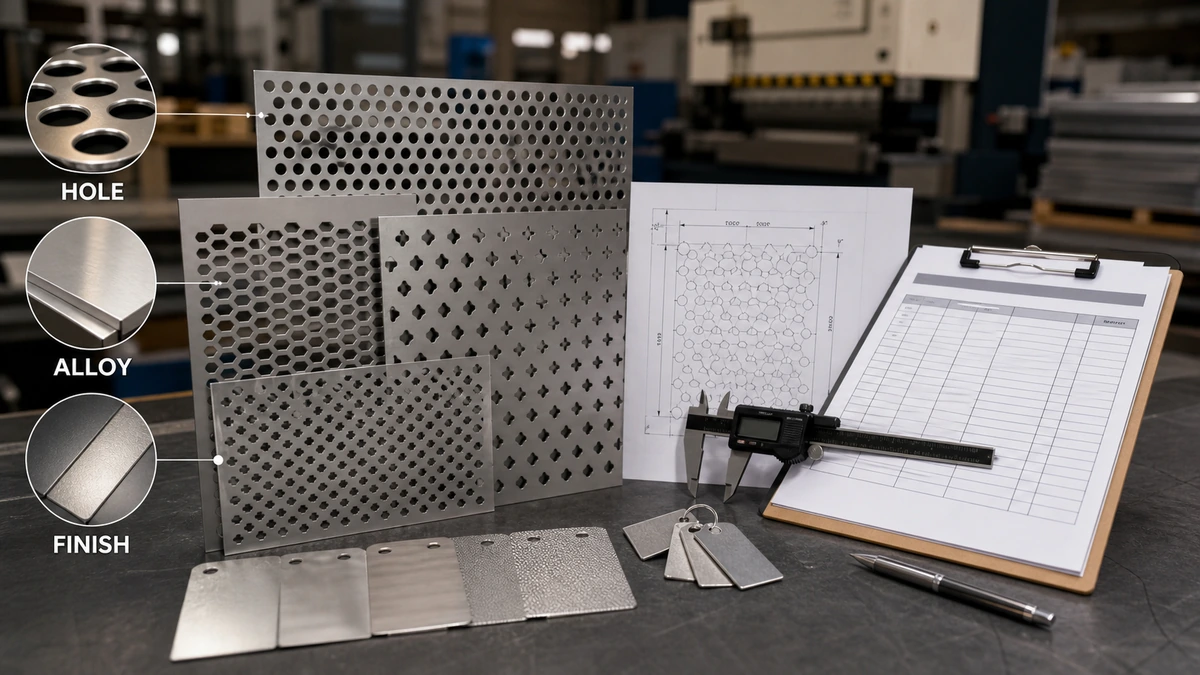
Buyers should send the required alloy, temper, thickness, sheet size, hole shape, hole size, pitch, pattern orientation, open area, blank margins, tolerances, finish, flatness, burr direction, drawings, quantity, packing, and delivery destination. Perforated aluminum sheet manufacturers cannot prepare comparable quotes from a reference photo or hole diameter alone because tooling, yield, finishing, and inspection scope may differ.
A complete RFQ allows every supplier to price the same finished product. It also exposes technical questions before tooling, sample approval, or bulk production.
What Perforated Aluminum Sheet Manufacturers Need in an RFQ
| RFQ field | Example of a complete instruction | Why it affects price or feasibility |
|---|---|---|
| Alloy and temper | State the exact ordered material and governing specification | Controls formability, strength, finish behavior, and availability |
| Thickness | Finished or incoming thickness with tolerance | Affects punching load, flatness, weight, and cost |
| Sheet size | Finished width and length | Influences material yield and machine setup |
| Hole shape | Round, square, slot, hexagonal, decorative, or drawing-defined | Determines tooling and punching sequence |
| Hole size | Diameter or complete geometry with tolerance | Defines tooling and inspection |
| Pitch | Center-to-center spacing in both axes | Sets ligament and open area |
| Pattern | Straight, staggered, or drawing-defined | Changes appearance and open area |
| Margins | Blank border on each edge plus internal unperforated areas | Affects layout and fabrication |
| Finish | Mill, anodized, coated, brushed, or other approved system | Changes processing route and surface acceptance |
| Secondary work | Cutouts, bending, forming, welding, framing, or assembly | Determines whether the quote is for sheet or finished panel |
1. Identify Alloy, Temper, and Governing Specification
Do not request “standard aluminum.” State:
- Alloy.
- Temper.
- Material specification and edition.
- Required certificate or inspection document.
- Whether a substitution may be proposed.
The correct combination depends on structural, forming, corrosion, appearance, and fabrication requirements. If the design is not finalized, describe the service and allow suppliers to submit separately priced alternatives for engineering review.
TOP METAL supplies aluminum sheet and aluminum perforated plate across a broader aluminum product range. The exact offered alloy, temper, and certificate must be confirmed in the quotation.
2. Define Hole Geometry With a Drawing
A hole specification requires more than diameter.
For round holes, state:
- Hole diameter.
- Center-to-center pitch.
- Straight or staggered pattern.
- Pattern angle or orientation.
- Hole and pitch tolerances.
- Minimum ligament if controlled.
- Start point and direction.
For slots or decorative shapes, include the complete geometry, corner radii, orientation, and spacing. Use a dimensioned PDF for quotation and provide DXF or another agreed production file after revision control is established.
3. State Open Area as a Requirement, Not a Guess
Open area affects airflow, light transmission, acoustic backing exposure, screening, pressure drop, weight, and appearance. It is determined by the hole shape, hole size, pitch, and pattern.
If performance is governed by open area, state the required value or range and the calculation basis. If appearance governs, prioritize the approved drawing and sample. Do not specify a hole pattern and an incompatible open-area target without identifying which requirement takes precedence.
Ask the supplier to confirm:
- Calculated open area.
- Pattern used in the calculation.
- Treatment of blank borders and solid zones.
- Whether the value applies to the perforated field or the entire finished panel.
4. Draw Every Blank Margin and Solid Zone
Unperforated areas are often required for:
- Fasteners.
- Frames.
- Bends and returns.
- Welding.
- Logos or labels.
- Access openings.
- Panel joints.
- Structural attachment.
Dimension the top, bottom, left, and right margins independently. Show internal solid strips and excluded zones on the drawing. “Standard border” is not a reliable production instruction.
The supplier should also confirm how the pattern terminates at each edge. Partial holes at a visible border can create an unacceptable appearance even when the overall panel size is correct.
5. Define Flatness, Burr Direction, and Visible Face
Perforation changes residual stress and may affect flatness. The buyer should state:
- Flatness requirement and measurement method.
- Whether leveling is required after perforation.
- Visible face.
- Permitted burr height or edge condition.
- Burr direction.
- Scratch and handling acceptance.
- Protective-film requirement.
If the panel will be bent or framed, identify the sequence. Punching before forming and punching after forming are not interchangeable routes.
6. Connect the Finish to the Production Sequence
State whether the material is:
- Mill finish.
- Brushed.
- Anodized.
- Color coated.
- Powder coated.
- Another project-specific finish.
The RFQ should specify color, gloss, finish thickness or reference where applicable, visible-face quality, protective film, and sample approval. Ask whether finishing occurs before or after perforation and how exposed hole edges will appear.
TOP METAL lists a 1100/1060 alloy perforated sheet product and a decorative perforated aluminum sheet as possible references. Treat product-page descriptions as starting points; confirm the offered specification for the order.
7. Clarify Tooling, Sample, and Revision Control
Ask the manufacturer to separate:
- Existing-tool pattern price.
- New-tool charge.
- Sample or first-article charge.
- Bulk unit price.
- Tool ownership and storage terms.
- Revision-change consequences.
Every drawing should have a number, revision, date, and unit. The purchase order should identify the approved revision and sample. If a new pattern is created, approve the first article before bulk release.
Perforated Aluminum Sheet RFQ Checklist
Material
- Alloy and temper:
- Material standard:
- Thickness and tolerance:
- Required certificate:
- Substitutions permitted:
Pattern
- Hole shape:
- Hole dimensions:
- Pitch in each direction:
- Straight/staggered pattern:
- Pattern orientation:
- Open-area requirement:
- Hole and pitch tolerance:
- Burr limit and direction:
Panel
- Finished width and length:
- Quantity by size:
- Blank margins:
- Internal solid zones:
- Cutouts:
- Flatness:
- Visible face:
- Edge treatment:
Finish and fabrication
- Finish and color:
- Gloss:
- Protective film:
- Bending, framing, or welding:
- Drawing file and revision:
- Sample/golden sample:
Commercial
- Sample quantity:
- Bulk quantity:
- Tooling ownership:
- Packing:
- Destination:
- Delivery schedule:
Normalize Commercial Quotations
Each quotation should state sample and production quantities, minimum order quantity, alloy and temper, sheet or finished-part scope, tooling or programming charges, approved drawing revision, surface finish, protective film, flat packing or crating, destination, and lead time after sample approval. Ask what customization is included and which material certificates, inspection records, or project standards can be supplied. Price is affected by alloy, thickness, hole pattern, open area, blank margins, sheet size, tolerances, secondary fabrication, finish, yield, packing, and freight.
Frequently Asked Questions
Why do quotations differ for the same hole diameter?
The pitch, pattern, open area, margins, alloy, thickness, flatness, finish, tooling, secondary fabrication, inspection, quantity, and packing may be different.
Is open area calculated over the whole panel?
Not always. It may refer to the perforated field rather than the entire finished sheet. State the required basis and ask the supplier to show the calculation.
Should the buyer send DXF or PDF?
Send a dimensioned PDF for human review and an agreed CAD file for production. Both should carry the same drawing number and revision.
Does burr direction matter?
Yes when the panel has a visible face, touches other components, receives a coating, or requires safe handling. Mark the visible face and required burr orientation.
When is a first article necessary?
Use one for new tooling, tight visual requirements, complex margins, secondary forming, or a finish that must match an approved sample.
Request a Comparable Quotation
TOP METAL supplies aluminum sheet, coil, circles, tread plate, profiles, grating, and custom aluminum products for B2B orders. Send the completed RFQ, drawing, sample reference, quantities, finish, packing, destination, and schedule with your inquiry through the aluminum sheet product category. Require the quotation to list tooling, sample, bulk scope, documents, and every deviation separately.
Request a perforated aluminum sheet quotation with the material, pattern, fabrication, inspection, packing, and delivery details required for a comparable offer.