
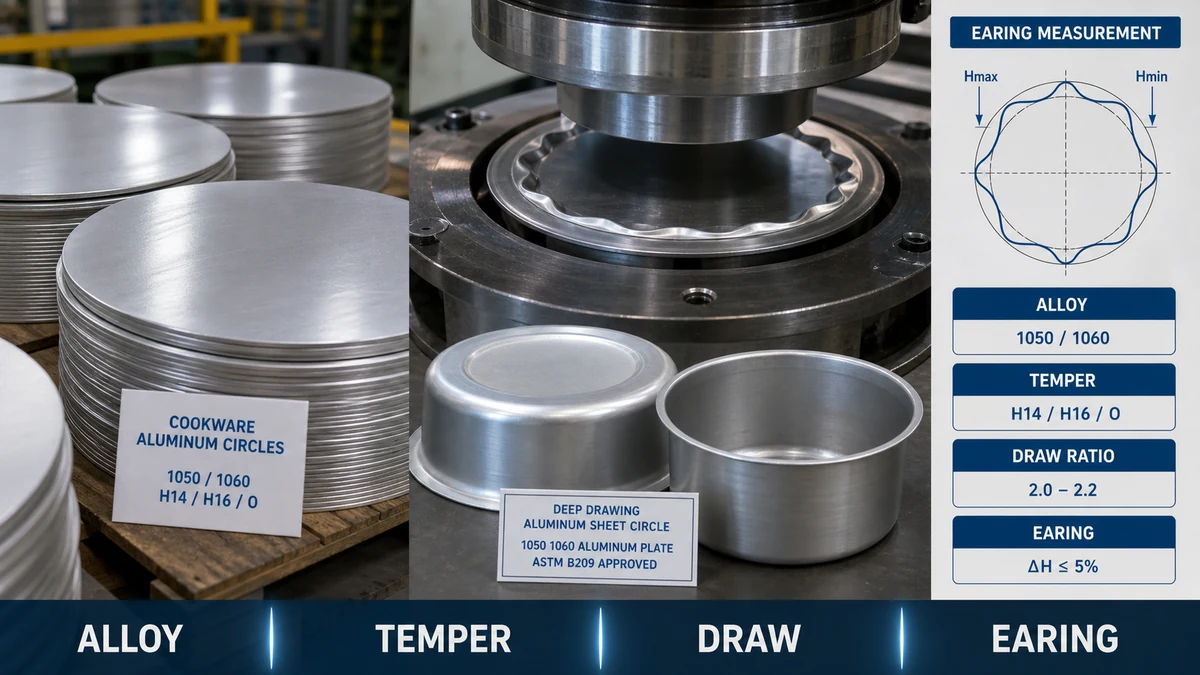
No single alloy and temper is automatically suitable for every cookware design. Buyers should specify cookware aluminum circles from the finished vessel geometry, draw depth, redraw sequence, tooling, required wall distribution, earing limit, surface finish, and forming-trial result. The safest choice is the material condition that performs consistently on the buyer’s actual press and tooling—not simply the lowest-priced circle described as “soft aluminum.”
This decision is relevant to cookware manufacturers, stamping plants, utensil brands, OEM factories, and purchasing engineers producing frying pans, saucepans, stock pots, pressure-cooker bodies, lids, and related formed parts. Buyers can begin with the available aluminum circle product range, then narrow the inquiry by application, alloy, temper, dimensions, forming route, and acceptance criteria.
Why Does the Same Aluminum Circle Perform Differently in Different Cookware Tools?
Deep drawing is controlled by the interaction between the blank and the production process. A circle that forms well into a shallow frying pan may show excessive ears, wall thinning, wrinkles, or splits when used for a deeper pot or a multi-stage redraw. Material designation alone cannot describe that complete forming system.
| Decision Factor | What the Buyer Should Define | Risk if It Is Missing |
|---|---|---|
| Finished vessel geometry | Final diameter, depth, bottom profile, wall shape, rim design, flange, and trimming allowance | The supplier cannot judge whether the blank is intended for a shallow draw or a severe multi-stage draw. |
| Forming route | Number of draws, redraw stages, spinning, ironing, trimming, rim forming, and downstream operations | A blank approved for one operation may fail after an additional redraw or wall-reduction step. |
| Alloy and temper | Exact alloy designation, temper, required property range, and approved production route | A generic “soft aluminum” description allows forming behavior to change between batches. |
| Blank dimensions | Diameter, thickness, tolerances, measurement method, and sampling plan | Dimensional variation changes draw severity, wall distribution, finished height, and trimming loss. |
| Earing acceptance | Measurement method, maximum ear height, trimming allowance, and rejection rule | The material can meet a chemical specification but still create excessive scrap and unstable finished height. |
| Surface and edge condition | Cleanliness, scratches, oil condition, burr, edge damage, flatness, and protective handling | Defects may initiate tearing or remain visible after forming, polishing, coating, or anodizing. |
How Should Buyers Start With Vessel Shape and Draw Ratio?
The finished-part drawing should be the first input to material selection. Buyers should provide more than the final diameter. The supplier also needs the vessel depth, bottom radius, wall profile, rim design, trimming allowance, and the number of forming stages.
A shallow pan and a deep stock pot may use similar nominal aluminum circles but impose very different material-flow requirements. Increasing the blank diameter without reviewing tool geometry can increase wrinkling or earing, while reducing the diameter too far can create insufficient finished height or localized thinning. The commercial specification should therefore connect blank dimensions to the approved forming route.
Common procurement errors include:
- Sending only the finished diameter: The supplier cannot evaluate draw depth, blank allowance, or redraw severity.
- Using one circle specification for several cookware shapes: A material proven on a shallow pan may not remain stable on a tall vessel.
- Ignoring tooling and lubrication: Die radius, blank-holder force, press speed, lubrication, and tool wear can change the result even when the material is unchanged.
- Comparing only nominal thickness: Thickness tolerance and batch consistency may matter more than the nominal number alone.
- Approving a small flat sample without forming it: Chemical and mechanical documents cannot replace a representative press trial.
How Should Buyers Compare Alloy and Temper Options?
The client product database supports cookware-related circles in 1050, 1060, 1070, 1100, and 3003, while other circle products list a wider range of alloys and tempers. However, the available product range does not establish one universal grade for every cookware design. Buyers should treat alloy and temper as trial variables tied to the finished part and production route.
| Selection Direction | Typical Procurement Priority | Buyer Verification |
|---|---|---|
| Softer commercially pure aluminum options | Formability, ductility, thermal conductivity, and severe drawing capability | Confirm temper, annealing consistency, wall distribution, earing, surface condition, and finished-part strength. |
| 3003-type cookware circles | A balance between formability and higher finished-part strength than commercially pure aluminum | Run a forming trial because draw depth, tooling, and temper can change split rate, ears, and springback. |
| Higher-strength alloy circles | Applications requiring greater strength, stiffness, or a specific downstream performance | Do not assume that higher strength improves deep drawing; verify ductility, bend response, trimming loss, and process capability. |
| Mill-finish versus anodized-quality blanks | Match the circle surface to the final cookware finishing route | Inspect scratches, stains, oil residue, handling marks, and consistency after forming and finishing. |
For a broad alloy and finish comparison, buyers can review polished and mill-finish round aluminum discs. For cookware programs centered on 1060, 1070, 1100, or 3003, the mill-finish cookware aluminum circle option provides a more directly matched product reference.
Why Is Temper Consistency More Important Than the Temper Name Alone?
The temper code should be confirmed in the purchase order, but batch-to-batch consistency is what determines whether the buyer can maintain one press setup. Variations in rolling history, annealing, mechanical properties, grain condition, and thickness can change drawing behavior even when the shipment carries the same nominal alloy and temper.
Buyers should therefore request:
- The exact alloy and temper offered for the quoted circle
- The applicable specification and property range used by the supplier
- Representative production samples rather than hand-selected laboratory pieces
- Lot identification linking trial blanks to later mass production
- Written control of any change in raw-material source, rolling route, or heat-treatment route
- A nonconformance process for batches that pass document review but fail the agreed forming trial
The website’s aluminum alloy guide can support early comparison, but final approval should remain linked to the cookware drawing and the buyer’s production trial.
How Should Earing Be Specified and Measured?
Earing is the uneven height that develops around the rim of a drawn cup. It affects trimming loss, finished height, line balance, and material yield. Buyers should not use “low earing” as an undefined quotation phrase. The RFQ should state how ears will be measured and what result is acceptable.
| Earing Control Item | Buyer Requirement | Commercial Impact |
|---|---|---|
| Trial part | Define the approved vessel, tool, draw sequence, and press conditions | Prevents results from an unrelated cup test being used as approval evidence. |
| Measurement method | Define the number of ears, measurement positions, reference height, and calculation method | Allows buyer and supplier to compare the same result. |
| Maximum acceptance | State the acceptable ear height or trimming allowance | Connects material approval to scrap cost and finished-part height. |
| Sampling frequency | Define samples per coil, lot, pallet, or shipment | Reduces the risk of approving one good trial while later lots behave differently. |
| Corrective action | Define hold, retest, replacement, sorting, or deviation approval rules | Prevents disputes after the material has entered production. |
How Do Thickness, Flatness, and Edge Quality Affect Deep Drawing?
Cookware circles should be inspected as forming blanks, not only as pieces of aluminum sold by weight. Several dimensional and handling details can affect the press result:
- Thickness consistency: Local or batch variation can change wall thinning, draw force, finished height, and split risk.
- Diameter tolerance: Inconsistent blank diameter changes available material volume and trimming allowance.
- Flatness: Distorted blanks can feed poorly, sit incorrectly in locating systems, or create uneven contact during the first draw.
- Edge burr: Burrs and damaged edges can interfere with handling and may become crack-initiation points during severe forming.
- Surface cleanliness: Embedded particles, stains, scratches, and inconsistent lubricant can remain visible after forming or affect downstream finishing.
- Packaging pressure: Poor stacking, moisture exposure, or movement during export can mark circles that were acceptable before packing.
What Should a Representative Forming Trial Include?
A forming trial should use material that represents the intended production route and should reproduce the buyer’s real process as closely as practical. A supplier sample that forms successfully in a different tool does not guarantee stable production at the buyer’s plant.
- Freeze the trial input. Record alloy, temper, thickness, diameter, surface, edge condition, lot, and raw-material route.
- Use the intended cookware tool. Record press, tool number, die and punch condition, lubrication, speed, blank-holder settings, and draw sequence.
- Measure the complete result. Check ear height, split rate, wrinkle condition, wall thickness distribution, finished height, surface marks, and trimming loss.
- Repeat enough parts. One successful piece is not evidence of production stability.
- Retain signed references. Keep approved blanks, formed parts, measurement records, and lot identification.
- Define mass-production matching. State which properties, dimensions, inspection records, and trial results must remain consistent.
What Happens in a Typical Deep-Drawn Stock Pot Program?
Scenario: Multi-Stage Cookware Body Production
Business Background: A cookware manufacturer plans a tall stock pot that requires an initial draw, one redraw, trimming, and rim forming. The buyer previously used a circle specification developed for a shallower saucepan.
Problem: The new trial produces acceptable cups in the first draw, but the redraw creates uneven finished height, high ears, and occasional splits. Purchasing initially assumes that ordering a softer temper will solve the issue.
Cause: The original RFQ included only alloy, nominal thickness, and circle diameter. It did not define the deeper vessel geometry, redraw sequence, earing limit, wall-thickness target, edge condition, or press-trial method. The blank diameter and temper were therefore selected without the complete forming conditions.
Recommended Solution: The buyer sends the finished drawing and process route, then compares representative alloy-and-temper samples under the actual tooling. The trial records ear height, wall distribution, trimming loss, split rate, and surface condition. The approved circle is then frozen by alloy, temper, dimensions, lot traceability, trial result, and change-control requirements.
Buyer Decision Value: A slightly higher material quotation can be commercially preferable when it reduces trimming loss, press stoppages, sorting, rework, and rejected cookware bodies. The decision should compare cost per accepted formed part rather than price per kilogram alone.
How Should Buyers Compare Price and Forming Reliability?
| Quotation Approach | Short-Term Advantage | Hidden Risk | Recommended Use |
|---|---|---|---|
| Lowest price with generic alloy and “soft temper” | Fast comparison and lower initial material cost | Unclear batch consistency, earing control, trial evidence, and responsibility for press failure | Only for noncritical forming where the buyer accepts wider variation. |
| Defined alloy, temper, dimensions, and inspection | More comparable quotations and lower receiving risk | Still may not prove performance in a severe or unusual tool | Suitable for established parts with stable historical production. |
| Representative forming trial with production controls | Strongest evidence of actual process compatibility | Requires sample time, press capacity, measurements, and approval records | Preferred for new cookware designs, deeper draws, redraws, or costly rejection risk. |
What Should a Cookware Aluminum Circle RFQ Include?
To receive a configuration-specific quotation, buyers should provide:
- Finished cookware drawing with diameter, depth, bottom radius, wall profile, rim, and trimming allowance
- Number of draws, redraws, spinning, ironing, trimming, and rim-forming operations
- Requested alloy and temper, or permission for the supplier to propose trial options
- Circle diameter, thickness, tolerances, quantity, and forecast
- Mill-finish, anodized-quality, polished, or other surface requirement
- Flatness, edge, burr, cleanliness, lubrication, and packaging requirements
- Earing measurement method, maximum acceptance, split rate, and wall-distribution criteria
- Sample quantity, trial schedule, approval authority, and mass-production change-control rules
- Required quality documents, lot traceability, inspection records, shipping marks, destination, and Incoterm
- Target delivery date and any limits on partial shipment or mixed production lots
Frequently Asked Questions
Which alloy is best for cookware aluminum circles?
There is no universal best alloy. The suitable choice depends on vessel depth, draw ratio, redraw stages, tooling, target strength, surface finish, and trial performance. Commercially pure aluminum and 3003-type options are common directions, but the final selection should be approved on the buyer’s cookware tool.
Is O temper always required for deep drawing?
No. Softer tempers may support demanding forming, but the correct condition depends on the alloy, finished-part requirements, tooling, and process route. Buyers should specify the exact temper and approve representative production material by trial.
Can a mill test certificate prove that the circle will not ear?
No. A certificate can support alloy, chemistry, and mechanical-property verification, but earing is a forming result affected by material condition and the buyer’s process. A controlled forming trial and defined measurement method are still required.
Why do two batches with the same alloy and temper form differently?
Differences in rolling history, annealing consistency, grain condition, thickness, flatness, surface condition, lubrication, tooling, and press settings can change the result. Lot traceability and process records help separate material variation from production variation.
Should buyers approve one sample or several trial blanks?
Several representative blanks should be tested. One successful part cannot show batch stability, split frequency, earing consistency, or normal process variation. The trial quantity should reflect the severity and commercial risk of the part.
What should be measured after the cookware trial?
Typical checks include ear height, split and wrinkle rate, finished height, wall-thickness distribution, trimming loss, surface marks, flatness, and downstream finishing performance. The exact acceptance list should match the cookware design.
How should aluminum circles be packed for export?
Packing should protect the circle surface and edges from moisture, movement, abrasion, impact, and excessive stacking pressure. Buyers should define bundle or pallet weight, interleaving, wrapping, labels, lot identification, and unloading conditions in the RFQ.
Request a Cookware Circle Forming Review
For a project-specific evaluation, provide the cookware drawing, forming sequence, requested alloy and temper, circle diameter, thickness, tolerances, quantity, target surface, earing limit, trial requirements, packaging, destination, and delivery schedule through the TOP METAL quotation and technical review page. The supplier can then review available aluminum-circle options, sample requirements, customization, inspection scope, lot control, export packing, MOQ, lead time, and quotation boundaries before bulk production.
Request a cookware aluminum circle quotation with the cookware drawing, forming route, alloy and temper requirements, dimensions, trial criteria, packing and delivery details needed for a comparable offer.