
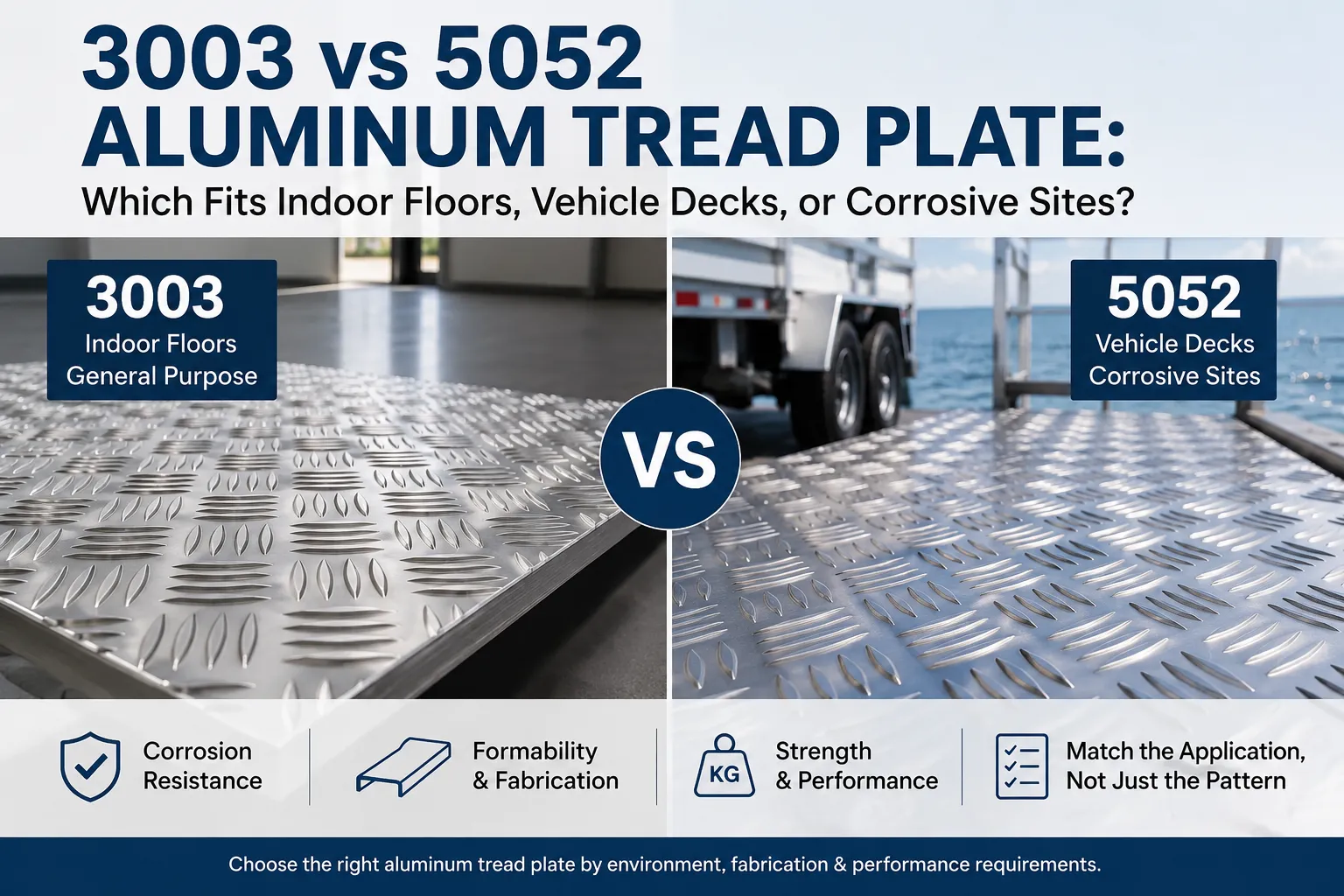
Direct Answer: Choose 3003 or 5052 aluminum tread plate by the operating environment and fabrication route, not by the tread pattern alone. For general indoor flooring, 3003 can be a practical candidate when the approved design basis is moderate. For vehicle decks or more corrosive service, buyers often evaluate 5052 first, then confirm temper, thickness, forming, joining, finish, and project-specific performance requirements.
Aluminum tread plate is often purchased by a simple description such as “diamond plate,” “checker plate,” or a nominal thickness. That is rarely enough for a B2B order. The raised pattern is only one visible part of the specification; the alloy, temper, thickness basis, panel size, forming route, welding or fastening method, surface expectation, and service environment can change whether two quotations are truly comparable.
TOP METAL supplies aluminum sheet, tread/checker plate, diamond tread sheet and other aluminum products for global industrial, construction and fabrication buyers. Buyers can start from the Aluminum Sheet category and then review tread-plate product options, but the purchase decision should begin with the application rather than the catalogue pattern.
The Same Tread Pattern Can Hide a Different Material Decision
Two plates can look nearly identical from above while using different alloy and temper combinations. If a buyer compares only the pattern, width, length and unit price, the quotation may hide differences that matter later during bending, cutting, welding, installation or service.
That is why the first useful question is not “Which alloy is stronger?” It is “What does this part need to do after it reaches the jobsite or fabrication shop?” The answer should cover the environment, expected loading basis, fabrication route, visual requirements and maintenance conditions. Only then does a 3003-versus-5052 comparison become meaningful.
| Decision Area | What the Buyer Should Define | Why It Changes the Alloy Choice |
|---|---|---|
| Application | Indoor floor, stair surface, equipment platform, vehicle deck, service panel, or outdoor/corrosive location | Different applications place different priorities on forming, strength, corrosion exposure and finish. |
| Environment | Dry indoor, wet, wash-down, road exposure, salt or chemical exposure where relevant | The environment may move corrosion resistance higher in the selection criteria. |
| Fabrication | Flat use, bending, forming, cutting, welding, riveting or bolting | Fabrication can be as important as the final service condition. |
| Thickness basis | Define whether the quoted thickness refers to base metal or another agreed measurement basis | Pattern height can make nominal comparisons misleading. |
| Engineering basis | Project load, stiffness, support spacing and other requirements from the buyer's design team | Alloy alone does not determine whether a plate is suitable for a structural use. |
Where Does 3003 Tread Plate Usually Make Sense?
For procurement, 3003 is commonly considered when the application is a general-purpose patterned sheet and the buyer values workable fabrication with a practical material choice. Indoor service floors, light-duty access panels, wall or equipment protection, and fabricated covers can fall into this type of decision path when the project engineer has already defined the required load and thickness basis.
That does not mean 3003 is automatically the correct choice for every indoor floor. The plate still has to satisfy the actual project requirements. Buyers should confirm the approved alloy and temper, base thickness, tread pattern, dimensions, tolerances, support condition and fabrication route before treating the quotation as equivalent to another offer.
For a broader product reference, buyers can review TOP METAL's Aluminum Checkered Plate Tread page while preparing the specification. The product page can support shortlisting, but the order should still state the exact alloy/temper and application requirements.
When Does 5052 Become the More Relevant Candidate?
5052 is often evaluated first when the application puts more emphasis on corrosion exposure, service durability or a more demanding combination of forming and end-use requirements. Vehicle decks, transport-related panels, outdoor platforms, wash-down areas or more corrosive operating environments are examples where buyers may place 5052 higher on the shortlist.
The key word is may. A corrosive environment does not automatically approve 5052 for the whole project, and a vehicle application does not automatically make 3003 unsuitable. Temper, thickness, support, joining method, surface condition, inspection requirements and the buyer's engineering basis still govern the final decision.
For patterned sheet comparisons, the Aluminum Diamond Plate Sheet page is another relevant product reference. Buyers should use product pages to identify available product families and then request confirmation for the exact alloy and fabrication scope needed by the order.
Indoor Floor, Vehicle Deck, or Corrosive Site: How Should Buyers Compare Them?
The application is more useful than a generic “3003 versus 5052” ranking. The table below shows a buyer-oriented decision path rather than a universal engineering approval.
| Application Scenario | What Usually Drives the Decision | Procurement Direction |
|---|---|---|
| Indoor service floor | Load basis, support spacing, thickness, fabrication, cleanability, cost and appearance | 3003 can be a practical candidate where the project requirements are moderate; verify the approved temper and thickness. |
| Indoor stair or platform panel | Support, bending/forming, edge detail, fastening, wear and any project-specific anti-slip requirement | Do not select by pattern alone; compare alloy/temper with the fabrication and structural basis. |
| Vehicle deck or transport panel | Weight, stiffness/strength requirement, forming, joining, vibration, weather and road exposure | 5052 is often shortlisted, but the buyer should verify the exact temper, thickness and joining method. |
| Wet or wash-down area | Water exposure, cleaning chemicals, drainage, maintenance and surface condition | Corrosion resistance becomes more important; compare the approved alloy and finish rather than relying on the tread name. |
| More corrosive site | Actual chemical/salt exposure, service life expectation, joints, fasteners and inspection basis | 5052 may be preferred as a candidate, but the environment must be defined before supplier confirmation. |
Temper Can Change the Result Even When the Alloy Number Stays the Same
A buyer who specifies only “3003 tread plate” or “5052 tread plate” has not finished the material definition. Temper affects how the sheet behaves during forming and fabrication, so the RFQ should state the required temper when it is already defined by the drawing or project specification.
If the buyer has a performance requirement but has not selected a temper, it is better to describe the forming operation and end-use condition than to guess. For example, tell the supplier whether the plate remains flat, requires bending, will be welded, or needs edge forming. The supplier can then discuss available material options against the stated fabrication route, while the buyer retains responsibility for final engineering approval.
Base Thickness and Raised Pattern Should Not Be Mixed in Quote Comparison
One of the easiest ways to create a misleading tread-plate comparison is to use “thickness” without defining how it is measured. Raised patterns add height above the base sheet. If one supplier quotes a base-metal thickness and another describes an overall dimension that includes the raised pattern, the buyer may believe the offers are equal when they are not.
For every quotation, define:
- the required thickness basis;
- the allowed tolerance or governing standard if applicable;
- the tread or checker pattern required;
- sheet width and length;
- pattern orientation if it matters to appearance or fabrication;
- whether finished dimensions are before or after cutting/forming.
The same discipline helps with weight and logistics. If a project needs accurate shipment planning, the buyer should compare the same thickness basis, dimensions and quantity instead of relying on a generic weight estimate.
The Pattern Does Not Prove Anti-Slip Performance
Raised tread patterns are commonly chosen where buyers want more surface texture than a plain sheet, but the presence of a diamond or checker pattern should not be treated as a guaranteed slip rating. Real performance depends on the installed slope, contamination, footwear, drainage, wear, cleaning and any applicable project standard or test method.
For procurement, separate the visual pattern from the engineering requirement. If the project needs a defined slip-resistance value, test method or code requirement, put it in the RFQ and request the relevant evidence for the exact product. Do not assume that the words “anti-slip tread plate” establish compliance.
How Do Cutting, Bending and Welding Change the Selection?
The best alloy for the installed panel may not be the easiest material for the planned fabrication route. A buyer should therefore treat fabrication as part of material selection rather than something that happens after purchasing.
Before asking for a quotation, tell the supplier whether the plate will be:
- cut to finished size;
- laser, saw, shear or waterjet cut;
- bent or brake formed;
- welded into a deck or frame;
- riveted, bolted or mechanically fastened;
- used with visible edges that need a defined finish;
- installed pattern-up with a specified orientation.
TOP METAL's existing article on Application-Based Aluminum Alloy Selection is useful background when a buyer needs to define the application before locking the alloy. For tread plate specifically, the final RFQ should still state the fabrication route and exact order requirements.
What Should Buyers Request as Material and Inspection Evidence?
Documentation should match the order rather than follow a generic checklist. Depending on the buyer's project and internal quality requirements, the RFQ may call for material identification, alloy/temper confirmation, dimensions, thickness checks, surface/pattern inspection, quantity verification, packing information or other order-specific records.
If the project has a governing standard, certificate requirement or inspection plan, state it explicitly. TOP METAL's company scope supports bulk supply and export project support, but the presence of a product on the website should not be treated as proof of a certification or performance value that has not been confirmed for the order.
Scenario: Why Can the “Cheaper” Tread Plate Become the Wrong Purchase?
Representative scenario — not a claimed customer case.
Business Background: A fabricator requests aluminum tread plate for two jobs: an indoor maintenance floor and a vehicle service deck. The first RFQ asks only for sheet size, tread pattern and quantity.
Problem: One supplier quotes a 3003 option for both jobs, while another proposes a 5052 option for the vehicle deck. The prices differ, but the buyer cannot tell whether the difference reflects alloy, temper, thickness basis, fabrication scope or service environment.
Cause: The RFQ treats both applications as the same “diamond plate” requirement and does not define corrosion exposure, forming, joining, support condition or the measurement basis for thickness.
Solution: The buyer separates the two applications. The indoor floor RFQ states its engineering load basis, support spacing, required temper, thickness basis and fabrication. The vehicle deck RFQ adds weather/corrosion exposure, joining method and service requirements. Both suppliers then quote against the same fields.
Buyer Decision Value: The buyer can decide whether 3003 or 5052 fits each job based on total application requirements rather than assuming one alloy should cover every patterned-plate order.
What Should a 3003 vs 5052 Tread Plate RFQ Include?
| RFQ Field | What the Buyer Should Provide |
|---|---|
| Application | Indoor floor, stair, vehicle deck, equipment platform, outdoor or corrosive-service use |
| Environment | Dry/wet exposure, wash-down, road/salt exposure, chemical exposure where relevant |
| Alloy / temper | Required alloy/temper if already approved, or performance/fabrication requirement for supplier review |
| Thickness | Define the thickness measurement basis, tolerance and any applicable project standard |
| Pattern | Diamond/checker/tread pattern, orientation and visible-face requirement |
| Dimensions | Sheet or finished-part length/width, cut-to-size requirements and quantity |
| Fabrication | Cutting, bending, forming, welding, fastening and edge-finish requirements |
| Engineering inputs | Project load, support and stiffness requirements provided by the design team where relevant |
| Quality documents | Material, dimensional, surface and other order-specific inspection records required by the buyer |
| Packing / delivery | Protection, bundle identification, destination and delivery sequence |
Frequently Asked Questions
Is 5052 always better than 3003 aluminum tread plate?
No. 5052 may be more relevant where corrosion exposure or more demanding service conditions are important, while 3003 can be a practical option for many general-purpose applications. The correct choice still depends on temper, thickness, fabrication and the project's engineering basis.
Can 3003 tread plate be used for indoor floors?
It can be considered for indoor flooring when the project engineer's load, support, thickness and service requirements are satisfied. Do not approve the alloy based on indoor use alone.
Why is 5052 often considered for vehicle decks?
Vehicle and transport applications can place more emphasis on corrosion exposure, fabrication and service durability, so buyers often include 5052 in the shortlist. Final suitability depends on the exact temper, thickness, joining method and design requirements.
Does diamond or checker pattern mean the plate is certified anti-slip?
No. Pattern geometry provides surface texture, but a project-specific slip rating or code requirement must be verified separately using the required test or evidence.
Should buyers specify base thickness or overall tread height?
The RFQ should clearly define the thickness measurement basis used for comparison. Otherwise, suppliers may quote different constructions under the same nominal number.
What information matters most before asking for a quote?
Application, environment, approved alloy/temper or performance requirement, thickness basis, dimensions, pattern, fabrication route, quantity, quality documents, packing and delivery information are the key starting points.
Can TOP METAL recommend an alloy from application information?
TOP METAL can review the stated application, alloy/temper, dimensions, surface and fabrication requirements and discuss available product options. Final engineering approval remains with the buyer's project specification and design authority.
Compare the Application Before Comparing the Price
For a useful 3003-versus-5052 quotation, send the application, operating environment, approved alloy/temper or required performance basis, thickness definition, pattern, dimensions, fabrication route, quantity, inspection documents and packing requirements through the Request Quote page. TOP METAL can review the tread-plate product and fabrication requirements against the information provided so the buyer can compare equivalent supply scopes instead of two visually similar but technically different offers.