
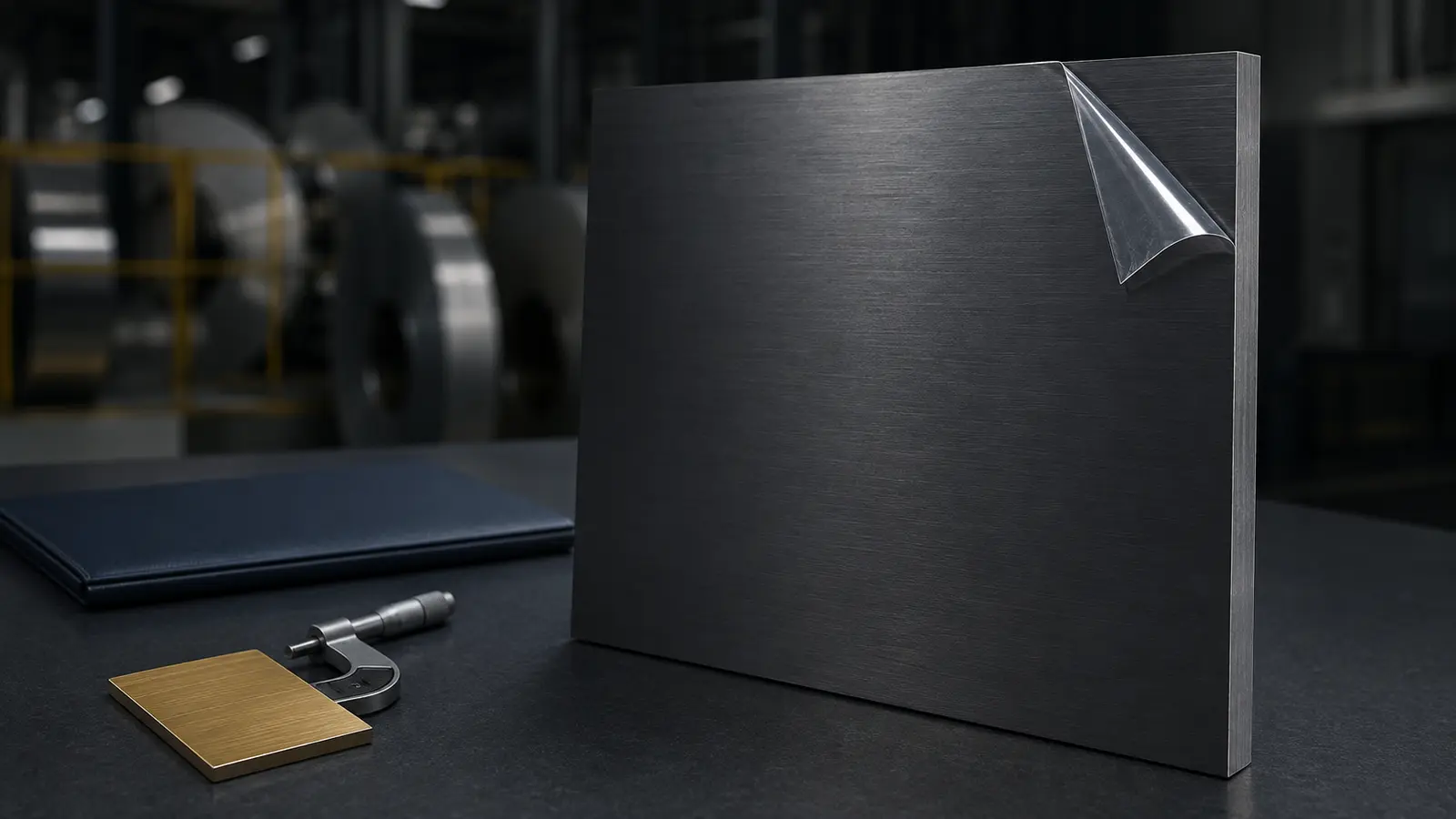
Direct Answer: Buyers should ask an anodised aluminum sheet supplier China sourcing teams are reviewing to define the base alloy, temper, thickness, sheet size, anodizing sequence, finish, color-control method, visible-side requirement, machining scope, inspection evidence, protective film, packing, and delivery responsibility. The supplier must also state which work is performed in-house, subcontracted, or supplied by an approved processing partner.
An anodized sheet quotation can look complete while leaving the most important boundary unresolved: whether the offer covers a finished anodized panel, a thick aluminum base plate, or substrate supply followed by separate finishing. Importers, enclosure manufacturers, signage producers, and architectural fabricators need that boundary before comparing prices, samples, or lead-time promises.
What Exactly Is the Supplier Being Asked to Deliver?
The RFQ should begin with a plain description of the delivered item. State whether the buyer needs full sheets, cut blanks, machined panels, or finished components. Then identify which faces and edges require anodizing, whether the part is anodized before or after cutting and machining, and who owns the final appearance and dimensional acceptance.
The anodized aluminum sheet range provides a category-level view of available finishes. Category coverage does not prove that every alloy, thickness, panel size, color, or machining route can be combined. A supplier should confirm the exact route in the quotation rather than rely on a general statement that custom anodizing is available.
One recurring source of dispute is the word “sheet.” The buyer may expect a finished heavy panel while the supplier assumes thin decorative material. Thickness, width, length, tolerance, flatness, edge condition, and finished-part form must appear on the RFQ line itself.
How Should Buyers Qualify the Base Aluminum Sheet?
Anodizing does not remove the need to control the substrate. Alloy, temper, production route, surface preparation, initial thickness, flatness, and material identity can affect fabrication and the final visible surface. Buyers should specify the engineering requirement first and treat finish as an additional controlled layer.
The scheduled topic points to the thick aluminum sheet supply route. The available page data emphasizes thickness, width, and length as order variables. It does not establish a universal alloy, thickness range, anodizing capability, surface tolerance, or finish result for every project. Those details require an order-specific review.
A material certificate verifies the stated substrate information when it is linked to the delivered sheet or plate. It does not verify color uniformity, gloss, brush direction, masking, or the appearance of machined edges. Procurement should keep substrate evidence and finish evidence as separate approval items.
Why Must the Fabrication and Anodizing Sequence Be Frozen?
Cutting, punching, bending, countersinking, engraving, and machining can expose new metal or change the visible surface. If a pre-anodized sheet is cut after finishing, the cut edge will not automatically carry the same anodized appearance as the original face. If a component is machined first and anodized later, racking contact, dimensional allowance, and the treatment of threaded or fitted areas may become relevant.
The buyer should provide a drawing that marks visible faces, protected zones, holes, threads, critical fits, and areas where contact marks are unacceptable. The supplier should return a process sequence showing where fabrication stops and anodizing begins. When another processor performs part of the work, the quotation should still assign responsibility for final inspection and nonconformance handling.
Late drawing revisions are especially risky for finished panels. A change that seems minor in CAD can alter brush direction, exposed edges, fixture contact, or film coverage. Drawing number and revision should appear on the quotation, sample record, production traveler, inspection report, and package label.
How Should Color, Texture, and Visible-Side Requirements Be Defined?
Color names such as black, bronze, gold, or natural are not complete acceptance criteria. Color can be influenced by substrate, surface preparation, batch, viewing angle, lighting, and the approved process. Buyers should use a physical limit sample or an agreed measurement method where appearance is critical, and define whether sheets from different production lots may be mixed on one installation.
The golden brushed anodised aluminum sheet illustrates a decorative product route with a brushed appearance and a protected prime side. Those page-specific statements should not be generalized to all anodized sheet. An RFQ for thick plate or a different color needs its own visible-face, grain-direction, outdoor-use, and protection review.
The article on when anodized sheet fits an application can support the initial finish decision. Supplier qualification must go further by defining what the finished order should look like, how it will be judged, and which variation remains acceptable.
Which Supplier Claims Need Supporting Evidence?
| Supplier claim | Buyer should clarify | Evidence to review | Risk if unresolved |
|---|---|---|---|
| “Custom thickness” | Starting and finished thickness, tolerance, sheet size, flatness, and measurement basis | Quotation, dimensional capability statement, and inspection format | The delivered plate fits the name but not the assembly |
| “Any anodized color” | Color reference, acceptable range, gloss or texture, batch rule, and lighting condition | Approved limit sample and batch-linked finish record | Commercial color names are interpreted differently |
| “One-stop processing” | Cutting, machining, brushing, anodizing, film, and inspection responsibility | Process sequence and subcontracting declaration | No party owns a defect found between operations |
| “Protected surface” | Film type, protected side, peel timing, adhesive-residue limit, and edge coverage | Approved sample and packing specification | Film damages the finish or fails during fabrication |
| “Consistent quality” | Lot definition, change notification, inspection frequency, and traceability | Sample report, production records, and package labels | The approved sample cannot be linked to bulk production |
| “Export packing” | Interleaving, corner protection, moisture barrier, pallet weight, and marks | Packing drawing and pre-shipment photographs | Visible surfaces are damaged before site inspection |
Evidence should match the risk. A decorative enclosure program may place greater emphasis on finish samples and protective film. A machined equipment plate may prioritize alloy identity, thickness, flatness, datum control, and the condition of fitted areas. Supplier audit questions should follow the finished part, not a generic checklist.
What Should the Sample and Inspection Plan Prove?
A small coupon can confirm color and texture under agreed lighting, but it cannot prove full-sheet flatness, grain direction, edge quality, or appearance across a large panel. Buyers should choose a sample format that represents the critical risk. A first article may be needed when the supplier also cuts, machines, bends, or applies protective film.
The inspection plan can include material-document review, alloy or lot identification, sheet dimensions, thickness, flatness where specified, finish appearance, color or gloss method where required, brush direction, visible defects, hole and edge details, film coverage, quantity, and package marks. Tests and tolerances should come from the drawing, governing specification, or agreed sample rather than be invented during final inspection.
For dimensional risk, the existing guide on aluminum sheet flatness RFQ details provides a useful companion reference. Flatness acceptance should still be tied to the actual panel size, support method, processing route, and measurement condition in the current order.
How Do Protective Film and Packing Change the Commercial Scope?
Protective film is part of the process, not a decorative extra. The buyer should confirm the protected side, film adhesion, application direction, peel window, compatibility with cutting or bending, and whether residue is acceptable. Film that is too weak may lift in handling; film that is too aggressive may complicate removal or mark the surface.
Finished sheets should be separated and restrained so that movement does not abrade visible faces. Edge and corner protection must suit the package weight and handling route. Moisture barriers, pallet construction, lifting access, package height, and maximum unit weight should reflect warehouse and site equipment.
A lower quotation may exclude protective film, interleaving, finish inspection, or custom pallet limits. Another offer may include those items. Buyers should compare the delivered, inspectable scope rather than assume every anodized sheet supplier uses the same export-packing standard.
What Happens When the Finish Boundary Is Missing?
Representative scenario — not a claimed customer case. An enclosure manufacturer sends an inquiry for thick black anodized aluminum panels. The drawing defines length, width, holes, and thickness but does not mark the visible face, brush direction, finish reference, protected areas, or whether machining occurs before anodizing.
One offer is based on pre-anodized sheet cut to size. Another includes machining followed by outsourced anodizing. Both may satisfy the short description, yet the resulting edge appearance, fixture marks, dimensional responsibility, film coverage, and inspection route differ. Comparing only the panel price hides the commercial and technical difference.
The buyer revises the RFQ with a finish sample, visible-face map, fabrication sequence, critical dimensions, masking details, acceptable contact areas, film specification, lot rule, inspection plan, and packaging limits. Suppliers can now quote comparable deliverables and list any deviation before production.
What Belongs in the Supplier Audit and Final RFQ?
- Finished application, drawing number and revision, visible faces, assembly interfaces, and service environment.
- Base alloy, temper, material specification, thickness, width, length, tolerances, and flatness requirement.
- Anodized finish, color reference, texture or brush direction, gloss requirement, and acceptable variation.
- Cutting, punching, bending, machining, deburring, cleaning, masking, and process sequence.
- In-house and subcontracted operations, process ownership, final inspection, and claim responsibility.
- Sample type, limit samples, first-article approval, lot definition, traceability, and change notification.
- Material documents, dimensional and finish records, sampling plan, and any third-party hold points.
- Protective film, interleaving, pallet limits, moisture and edge protection, package marks, and delivery terms.
Request a compliant base offer and place alternatives in a separate deviation list. A different substrate, finishing sequence, or sample method may be commercially useful, but the project team should approve the change rather than discover it after the panels arrive.
Questions Buyers Ask About Anodised Aluminum Sheet Suppliers
Can every thick aluminum sheet be anodized?
No universal assumption is safe. Alloy, temper, surface condition, dimensions, intended appearance, machining, and the anodizing processor's capability must be reviewed for the specific order.
Should machining happen before or after anodizing?
The finished-part requirements determine the sequence. Machining after anodizing exposes untreated edges and can damage the visible surface; anodizing after machining may require masking, racking allowances, and control of fitted areas.
Is a digital color value enough for approval?
Usually not when appearance is critical. A physical limit sample and an agreed inspection method provide a clearer commercial reference because substrate, texture, lighting, angle, and batch can change the perceived color.
What does a material certificate prove for anodized sheet?
A linked material certificate can verify specified substrate information. It does not by itself prove anodized color, texture, film quality, visible defects, flatness, or compliance with the finished-part drawing.
How should buyers audit subcontracted anodizing?
Ask who selects and controls the processor, which specifications and samples are transferred, how lots are identified, who performs final inspection, and which contracting party resolves finish or dimensional nonconformance.
Why must protective film be approved during sampling?
Protective film can affect appearance, fabrication, storage, and removal. Sampling allows the buyer to check adhesion, residue, edge lifting, process compatibility, and whether the protected side is clearly identified.
Request an Anodized-Sheet RFQ and Process-Boundary Review
Send the substrate specification, thickness and size, drawing, visible-face map, anodized finish reference, fabrication sequence, sample requirement, inspection plan, protective film, packing limits, quantity, and delivery destination through the TOP METAL quotation request page. The supplier can then confirm the proposed material and processing scope without hiding important assumptions inside the price.