
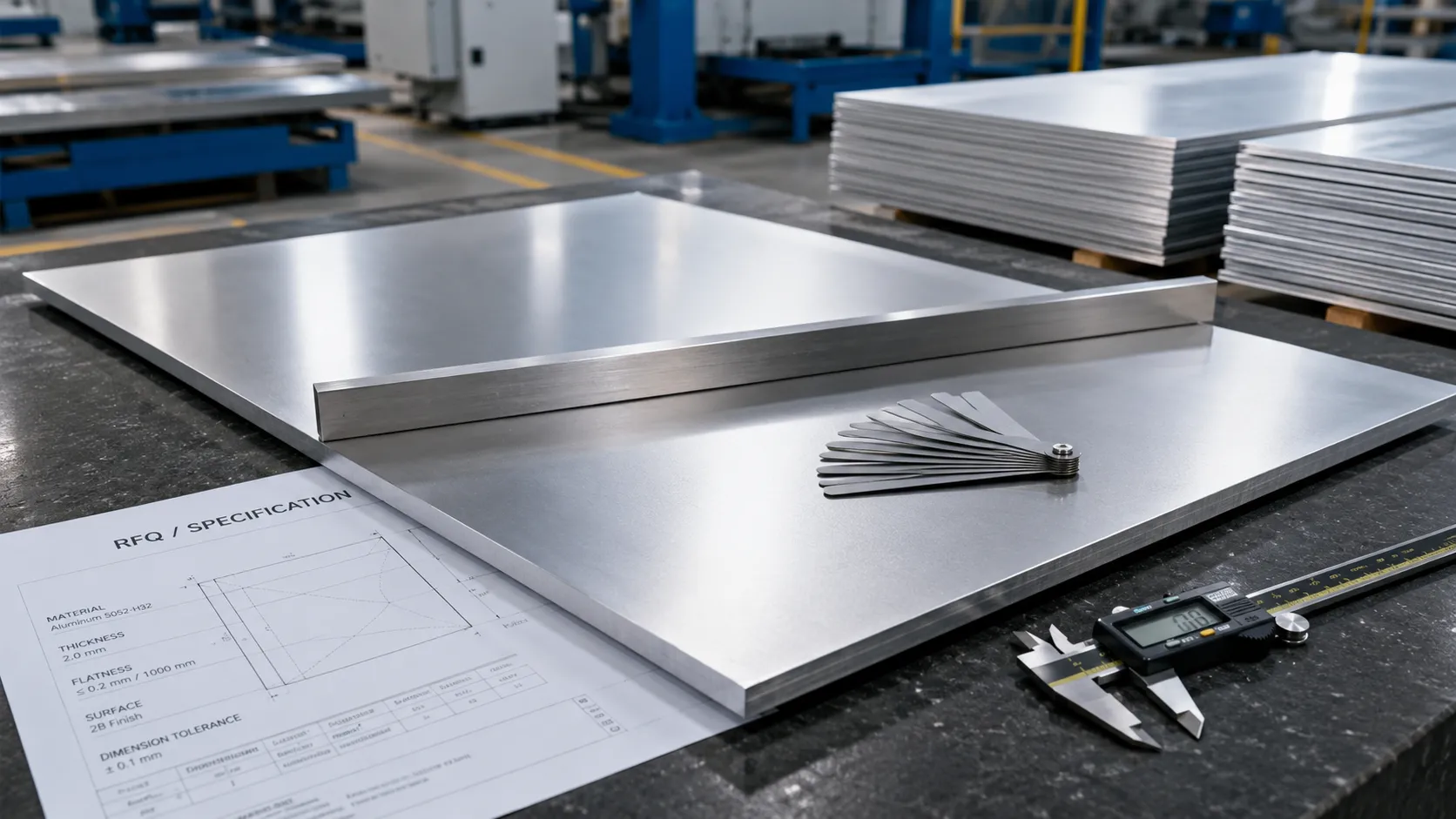
Aluminum sheet flatness should be specified before purchase, especially when the material will be laser cut, punched, bent, machined, laminated, or used as a visible panel. This matters to sheet-metal fabricators, enclosure manufacturers, automotive suppliers, sign makers, architectural contractors, and importers who need parts to stay within assembly tolerances after processing. The most important RFQ details are alloy and temper, thickness and sheet size, the required flatness tolerance and inspection method, cutting direction and part geometry, cut-to-size tolerances, surface protection, and export packaging. A sheet can meet its nominal thickness and still move after cutting if the temper, residual-stress condition, handling, or measurement method is unsuitable for the final part. This guide explains the seven details buyers should place in an aluminum sheet RFQ, how suppliers interpret them, which documents to request, and what information helps reduce warping, rework, and receiving disputes.
What Does Aluminum Sheet Flatness Mean for Buyers?
Aluminum sheet flatness describes how far the material surface deviates from a specified reference plane.
In practical purchasing, however, the word “flatness” can refer to several different requirements:
- The condition of a full sheet before processing
- The condition of a cut-to-size blank
- The flatness of a finished laser-cut or punched part
- Local waviness near an edge
- Bow across the sheet length
- Crossbow across the sheet width
- Twist between opposite corners
- Dimensional movement after material removal
These are not automatically the same requirement.
A supplier may confirm that the delivered sheet meets the applicable mill-product tolerance, while the buyer expects every finished cut component to remain within a much tighter assembly tolerance.
The RFQ should therefore distinguish between:
- Incoming material flatness
- Cut blank flatness
- Finished-part flatness
- Measurement conditions
- Responsibility for post-cutting deformation
ASTM B209/B209M is a widely referenced specification for aluminum and aluminum-alloy sheet and plate, but buyers should state the exact standard, edition and any tighter project requirement rather than writing only “standard tolerance.”
Buyers can review TOP METAL’s aluminum sheet range when comparing available flat-rolled materials, alloy series and cut-blank options.
RFQ Detail 1: Specify the Correct Alloy and Temper
The alloy number alone does not fully describe how an aluminum sheet will behave during cutting, bending or machining.
The temper is equally important.
For example:
- 3003-O and 3003-H14 do not have the same strength or formability.
- 5052-O is softer and more formable than 5052-H32 or H34.
- 6061-T6 and 6061-T651 are processed differently.
- Stress-relieved T651 plate is selected for different reasons than thin H-temper sheet.
The buyer should provide both:
Examples:
- 3003-H14
- 5052-H32
- 5052-O
- 6061-T6
- 6061-T651
- 7075-T651
Which aluminum alloy stays flatter after cutting?
There is no single alloy that remains flatter in every cutting process.
Final stability also depends on:
- Temper
- Product form
- Thickness
- Rolling history
- Residual stress
- Amount of material removed
- Component geometry
- Cutting sequence
- Clamping method
- Heat input
- Storage and handling
For general fabricated sheet-metal parts, 5052 aluminum sheet is commonly considered where corrosion resistance, workability and forming performance are important. TOP METAL currently lists 5052 in O, H32, H34, H36 and H38 tempers, with sheet thicknesses from approximately 0.2 to 6.0 mm.
For thicker, heavily machined components, a stress-relieved plate temper may be more appropriate. TOP METAL’s 7075-T651 aluminum plate is identified as stress relieved and intended to provide improved dimensional stability during machining.
Technical literature from Hydro also notes that stress-relieved T6511 material is produced to minimize residual stresses and improve machinability.
What should buyers include in the RFQ?
State:
- Required alloy
- Required temper
- Permitted alternative alloy, if any
- Final application
- Cutting or machining method
- Forming requirement
- Welding requirement
- Corrosion environment
- Required mechanical properties
- Required material standard
Avoid writing only:
A more useful request is:
If the correct grade is uncertain, buyers can use the Aluminum Alloy Selection Guide or submit the application conditions for supplier review.
RFQ Detail 2: Confirm Thickness, Width, Length and Product Form
Flatness requirements cannot be evaluated independently of material dimensions.
A 1 mm sheet and a 6 mm sheet do not have the same stiffness. A long, narrow strip may also behave differently from a square blank cut from the same parent sheet.
The RFQ should confirm:
- Nominal thickness
- Thickness tolerance
- Full sheet width
- Full sheet length
- Cut blank width
- Cut blank length
- Rolling direction
- Required quantity
- Sheet, plate or coil form
- Whether blanks are cut from sheet or leveled coil
TOP METAL currently lists its general aluminum sheet range at approximately 0.2–6.0 mm thick. Its 5052 sheet page lists widths from 100–2500 mm and lengths from 500–12000 mm, with custom slitting and cut-to-length services available.
These ranges describe supplier capability; the final achievable tolerance and flatness should be confirmed for the selected alloy, temper, thickness and order quantity.
Does thicker aluminum sheet warp less?
A thicker sheet normally has greater bending stiffness, but thickness alone does not guarantee stability.
A thick component may still move after cutting when:
- Large volumes of material are removed
- The part is machined heavily on one side
- Internal stress is released unevenly
- The design contains thin ribs or narrow frames
- Clamping pressure is uneven
- Thermal input is concentrated in one area
Thin sheet may be more sensitive to handling, stacking, suction lifting and local heat.
Instead of assuming that a thicker sheet will solve the problem, buyers should provide the final component drawing and intended processing method.
Should buyers order full sheets or cut-to-size blanks?
Full sheets may be suitable when the buyer has efficient nesting and cutting capability.
Cut-to-size blanks may be better when the buyer wants to:
- Reduce handling
- Reduce scrap
- Shorten preparation time
- Receive material by part number
- Protect visible surfaces
- Simplify warehouse control
The correct option depends on nesting efficiency, required tolerance, annual volume and freight costs.
RFQ Detail 3: Define the Flatness Tolerance and Measurement Method
Writing “must be flat” is not a measurable specification.
A usable RFQ should state:
- Maximum permitted deviation
- Measurement length or area
- Reference surface
- Measurement equipment
- Sheet support condition
- Temperature condition
- Whether protective film remains installed
- Whether the requirement applies before or after cutting
- Sampling quantity
- Acceptance criteria
How should aluminum sheet flatness be measured?
Possible methods include:
- Straightedge and feeler gauge
- Flat inspection table
- Dial indicator
- Height gauge
- Coordinate measuring machine
- Laser measurement system
The selected method should match the required tolerance.
For general commercial sheet, the buyer may reference an applicable material standard.
For precision panels, machine bases or closely fitted assemblies, the drawing may need a tighter project-specific requirement.
Why must the support condition be defined?
A thin aluminum sheet can change shape depending on how it is supported.
The measured result may differ when the sheet is:
- Suspended
- Placed on three points
- Placed on a complete flat table
- Clamped at the edges
- Measured with protective film
- Measured after unpacking
- Measured immediately after temperature change
The RFQ should explain how the supplier and buyer will reproduce the same inspection condition.
Incoming flatness versus finished-part flatness
A supplier can normally control the condition of the material or blank at delivery.
The supplier may not be able to guarantee final component flatness without knowing:
- Cutting program
- Part geometry
- Heat input
- Tool condition
- Clamping method
- Material removal sequence
- Forming operation
- Welding operation
A practical RFQ should state whether the supplier is responsible for:
- Mill sheet only
- Cut blank only
- Fully processed component
- Inspection after machining
RFQ Detail 4: Provide Cutting Direction and Part Geometry
Material movement often becomes visible only after the sheet is cut into a specific shape.
The following designs may be more sensitive:
- Long narrow strips
- Large rectangular frames
- Panels with a thin outside border
- Parts with large internal openings
- Asymmetric profiles
- Components with dense perforations on one side
- Parts with thin connecting webs
- Panels requiring extensive material removal
The supplier does not need every confidential design detail to prepare an initial quotation, but a simplified drawing can help assess cutting and stability risks.
Does rolling direction affect the finished part?
Rolling direction may affect:
- Forming behavior
- Bend performance
- Surface appearance
- Grain orientation
- Dimensional response during cutting
- Nesting direction
The RFQ should state whether the component must be aligned:
- Parallel to the rolling direction
- Perpendicular to the rolling direction
- In any direction
- With consistent orientation across all parts
This is particularly important for visible panels, bent components and repeat production.
What drawing information should be supplied?
Provide:
- Final part dimensions
- Internal cutouts
- Hole pattern
- Narrowest web width
- Bend lines
- Rolling-direction requirement
- Surface-side identification
- Flatness-critical areas
- Cosmetic areas
- Quantity per drawing
For CNC or heavily machined components, TOP METAL’s CNC Machining & Tooling solution recommends matching the stock form, temper, blank size and cutting allowance to the final geometry and amount of material removal.
RFQ Detail 5: Define Cut-to-Size Tolerances and Machining Allowance
Cut-to-size aluminum sheet should not be ordered only by its finished nominal dimensions.
The RFQ should identify:
- Blank width
- Blank length
- Width tolerance
- Length tolerance
- Squareness
- Diagonal difference
- Edge condition
- Burr allowance
- Saw-cut or shear-cut finish
- Machining allowance
- Part-number marking
What is machining allowance?
Machining allowance is additional material intentionally left on the blank so the buyer can finish the component to its required dimensions.
For example, if the final component is 500 × 300 mm, the buyer may require a slightly larger blank for milling or edge finishing.
The correct allowance depends on:
- Cutting method
- Final tolerance
- Edge quality
- Part geometry
- Fixturing method
- Machining sequence
The supplier should not guess the required allowance.
Does cut-to-size service eliminate warping?
No.
Cut-to-size service can improve material handling and prepare the correct blank geometry, but it cannot eliminate all movement caused by:
- Internal stress
- Thin geometry
- Heavy material removal
- Uneven heat
- Improper clamping
- Welding
- Forming
Buyers should treat cut-to-size service as one part of a complete material and processing plan.
What should be marked on each blank?
For projects with multiple parts, request labels showing:
- Buyer part number
- Alloy
- Temper
- Thickness
- Blank size
- Heat or batch number
- Drawing revision
- Quantity
- Surface side
- Rolling direction, if required
Clear identification reduces warehouse and production errors.
RFQ Detail 6: Confirm Surface Finish and Protective Film
Flatness is not the only acceptance requirement for visible aluminum sheet.
Architectural panels, equipment enclosures, signage and appliance parts may also require:
- Mill finish
- Brushed finish
- Anodized surface
- Painted surface
- Embossed surface
- One-side cosmetic quality
- Two-side cosmetic quality
- PVC or PE protective film
- Paper interleaving
- Specific film adhesion
- Specified film removal direction
TOP METAL states that it offers surface treatment and protective-film options alongside cut-to-size and slitting services.
Can protective film affect flatness inspection?
Protective film can affect how the sheet rests on an inspection surface, especially if:
- Film thickness is uneven
- Adhesive builds up near an edge
- Film is wrinkled
- Film is applied to one side only
- Air is trapped beneath the film
The RFQ should specify whether flatness is measured:
- Before film application
- After film application
- With film removed
- With film retained
Which side is the visible side?
Do not assume the supplier will know.
Mark the drawing with:
- A-side: visible or cosmetic side
- B-side: non-visible side
- Film side
- Directional finish orientation
For brushed or anodized panels, all pieces may need a consistent grain or finish direction.
RFQ Detail 7: Specify Packaging and Transportation Support
An aluminum sheet can leave the factory within tolerance and arrive damaged if it is not properly supported during handling and shipping.
Potential problems include:
- Edge bending
- Corner damage
- Sheet sagging
- Forklift impact
- Uneven pallet support
- Moisture staining
- Coil or sheet movement
- Excessive strap pressure
- Surface scratches
- Mixed-size stacking
What packaging should buyers request?
Depending on the product and route, the RFQ may include:
- Flat wooden pallet
- Reinforced export crate
- Full-length bottom support
- Waterproof wrapping
- Moisture barrier
- Desiccant
- Paper interleaving
- Protective film
- Edge protectors
- Corner protectors
- Steel or plastic strapping
- Size-separated packages
- Maximum package weight
- Lifting-point labels
TOP METAL describes seaworthy export packaging and custom processing support for sheet and plate orders. Its quote page also lists customized cutting, slitting and surface-treatment services.
Why does pallet design matter?
If a long sheet is supported only at a few narrow points, it may sag or be permanently deformed during storage and transport.
The package should distribute weight evenly and prevent movement between layers.
Buyers should state:
- Maximum package width and length
- Maximum gross weight
- Forklift access direction
- Crane-lifting requirements
- Warehouse stacking limits
- Whether the package will be opened outdoors
How should aluminum sheets be stored after delivery?
After receiving:
- Inspect the outer packaging before unloading.
- Photograph visible damage.
- Place packages on level supports.
- Keep sheets dry and ventilated.
- Avoid direct floor contact.
- Do not stack heavy items on thin sheets.
- Allow cold material to reach the indoor temperature before opening sealed packaging where condensation is a risk.
- Follow the agreed maximum stacking height.
Packaging and storage conditions should be part of the quality discussion when flatness is critical.
What Should Buyers Include in an Aluminum Sheet RFQ?
Use the following checklist:
| RFQ item | Information to provide |
|---|---|
| Application | Enclosure, panel, automotive part, sign, tooling or fabricated component |
| Alloy | 3003, 5052, 6061, 7075 or another grade |
| Temper | O, H14, H32, H34, T6, T651 or project-specific |
| Standard | ASTM B209, EN standard or another required specification |
| Thickness | Nominal thickness and permitted tolerance |
| Full sheet size | Width and length |
| Cut blank size | Width, length and quantity per size |
| Flatness | Maximum deviation and measurement span |
| Inspection method | Straightedge, table, dial indicator or other method |
| Cutting process | Shearing, sawing, laser cutting, punching or CNC machining |
| Part geometry | Drawing, openings, narrow sections and rolling direction |
| Cutting tolerance | Width, length, squareness and diagonal tolerance |
| Surface | Mill, brushed, anodized, coated or embossed |
| Protective film | Side, thickness, adhesion and color |
| Documents | MTC, inspection report or third-party certificate |
| Packaging | Pallet, crate, interleaving, film and edge protection |
| Quantity | Trial quantity and annual demand |
| Destination | Country, port and delivery address |
| Required date | Production completion and delivery schedule |
A complete RFQ enables the supplier to evaluate whether the requested flatness applies to standard sheet, precision blanks or stress-relieved plate.
What Quality Documents Should Buyers Request?
Depending on the project, buyers may request:
- Mill Test Certificate
- Chemical composition report
- Mechanical-property report
- Material standard confirmation
- Thickness inspection
- Width and length inspection
- Flatness inspection report
- Surface inspection
- Protective-film confirmation
- Packing list
- Certificate of conformity
- Third-party inspection report
Do not request every document by default.
Select documents according to:
- Application risk
- Customer contract
- Regulatory requirements
- Material value
- Inspection cost
- Destination-market requirements
For a critical dimension, the RFQ should identify:
- Inspection method
- Sample size
- Acceptance limit
- Responsible inspection party
- Required report format
What Are the MOQ, Customization and Lead-Time Considerations?
MOQ depends on:
- Alloy
- Temper
- Thickness
- Width
- Length
- Surface finish
- Protective film
- Cutting requirement
- Certification
- Whether the material is stocked
TOP METAL’s current quote page states a standard MOQ of approximately one metric ton, with possible trial quantities from 500 kg for some common stocked grades. Custom specifications may require approximately three to five tons. The same page lists an indicative production lead time of 15–30 days, although final MOQ and timing must be reconfirmed for each specification.
Available customization may include:
- Cut-to-size dimensions
- Slit widths
- Alloy and temper selection
- Tighter dimensional tolerances
- Surface treatment
- Protective film
- Paper interleaving
- Labels
- Pallet markings
- Buyer logo
- Inspection reports
Do not approve production until the final specification sheet or drawing has been confirmed.
What Determines the Price of Flat Aluminum Sheet?
The price depends on more than the aluminum market price.
Important factors include:
- Alloy series
- Temper
- Thickness
- Width and length
- Order quantity
- Standard or custom dimensions
- Flatness requirement
- Thickness tolerance
- Cut-to-size processing
- Slitting
- Surface finish
- Protective film
- Inspection and certificates
- Packaging
- Freight
- Delivery schedule
Tighter requirements usually increase:
- Material selection time
- Inspection time
- Rejection risk
- Processing steps
- Packaging requirements
- Production cost
Buyers should compare quotations based on the complete delivered specification, not only the price per kilogram or ton.
A useful quotation should show:
- Material price
- Processing charge
- Film or surface charge
- Inspection cost
- Packaging cost
- Estimated gross weight
- Trade term
- Lead time
- Quotation validity
How Should Buyers Evaluate an Aluminum Sheet Supplier?
Before ordering flatness-critical aluminum sheet, ask:
- Which alloys and tempers are regularly stocked?
- What thickness, width and length ranges are available?
- Which material standard applies?
- What standard flatness tolerance is supplied?
- Can a tighter flatness requirement be reviewed?
- How is flatness measured?
- Can an inspection report be provided?
- Can rolling direction be marked?
- Can blanks be cut to size?
- What cutting tolerances are available?
- Can protective film be applied?
- How are cosmetic surfaces protected?
- Can material be packed by part number?
- Which MTC or inspection documents are included?
- What is the MOQ?
- What is the production lead time?
- How is the material supported during export shipping?
- How are quality claims handled?
A reliable aluminum sheet supplier should identify incomplete requirements before production instead of offering a price from only the alloy and thickness.
Frequently Asked Questions
What is a reasonable aluminum sheet flatness tolerance?
There is no single tolerance for every alloy, temper, thickness and sheet size.
Buyers should reference the applicable material standard and state any tighter project-specific requirement, including the measurement span and inspection method.
Can an aluminum sheet meet ASTM B209 and still warp after cutting?
Yes.
Compliance with an incoming sheet or plate specification does not guarantee that every finished part will remain flat after laser cutting, punching or machining. Part geometry, residual stress, heat input and material removal can affect the result.
Which aluminum temper is best for preventing warping?
No temper is universally best.
For thick, heavily machined parts, stress-relieved T651 plate may improve dimensional stability. For formed thin-sheet parts, an H temper or O temper may be selected according to strength and formability requirements.
Does 5052 aluminum sheet stay flat after laser cutting?
5052 is widely used for fabricated sheet-metal parts, but its final stability depends on temper, thickness, parent-sheet condition, part geometry and cutting process.
Buyers should submit the drawing and flatness requirement rather than relying only on the alloy name.
Is thicker aluminum always flatter?
Not necessarily.
Thicker material has greater stiffness, but heavy machining, asymmetric cutting or residual stress may still cause dimensional movement.
Can a supplier guarantee flatness after the buyer cuts the sheet?
Usually not without reviewing and controlling the buyer’s complete processing method.
The supplier can more reasonably guarantee the delivered material or cut blank under an agreed inspection method.
Should flatness be measured before or after removing protective film?
The RFQ should define this condition.
Protective film may affect how thin sheet rests on an inspection surface, so the supplier and buyer must use the same measurement procedure.
What information should I send for an accurate quotation?
Send:
- Alloy and temper
- Thickness
- Width and length
- Quantity
- Flatness requirement
- Cutting drawing
- Surface finish
- Protective film
- Inspection documents
- Packaging
- Destination port
Reduce Aluminum Sheet Warping Before Production Starts
Aluminum sheet flatness cannot be controlled by writing only the alloy, thickness and quantity on a purchase order.
The buyer should confirm seven RFQ details:
- Alloy and temper
- Thickness and sheet dimensions
- Flatness tolerance and measurement method
- Cutting direction and part geometry
- Cut-to-size tolerance and machining allowance
- Surface finish and protective film
- Packaging and transportation support
When requesting a quotation, send TOP METAL:
- Final application
- Alloy and temper
- Required dimensions
- Cutting or machining drawing
- Flatness concern
- Surface requirements
- Quantity
- Inspection documents
- Packaging instructions
- Destination country or port
Request an aluminum sheet quotation to receive a material, temper, size and processing recommendation based on your fabrication requirements.