
How to Estimate Aluminum Bar Grating Weight Accurately
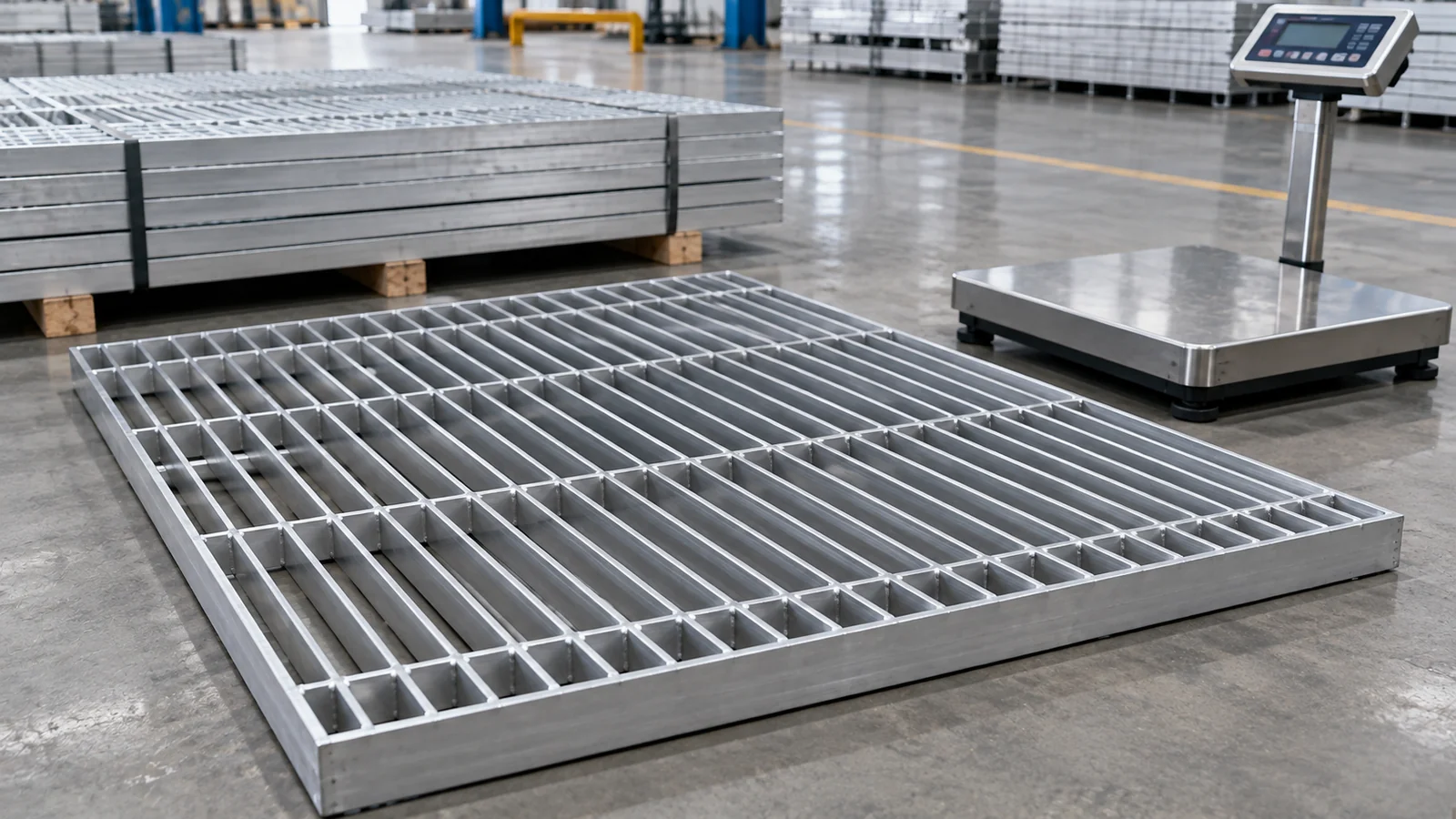
Aluminum bar grating weight is calculated from the actual volume of metal in the panel, multiplied by the density of the specified alloy. A grating panel is not a solid sheet: most of its plan area is open space. A useful estimate therefore starts with the bearing bars, then adds crossbars, edge banding and any other material included in the supplied panel. To convert the result into kg/m², divide the finished panel mass by the clearly defined panel area.
This distinction matters when engineers compare two grating designs, and when procurement teams check a supplier’s quoted net weight or plan shipping quantities. TOP METAL lists aluminum grating for walkways among its metal products, including different bearing-bar and crossbar arrangements. The following method is an engineering estimate, not a published mass value or load rating for any specific TOP METAL panel.
What Determines the Weight of Aluminum Bar Grating?
A grating’s outside length and width are only the starting point. Two panels with identical dimensions can contain different amounts of aluminum because the metal sections, spacing and edge details are different. For a rectangular bar-grating panel, review the following inputs before calculating.
| Input | Why it changes estimated mass | What to verify on the drawing |
|---|---|---|
| Bearing-bar section | Greater cross-sectional area increases material volume, with other inputs unchanged. | Actual profile shape, bar depth and thickness |
| Bearing-bar count and length | Each additional bar contributes its own length of metal. | Count, orientation, clear lengths and cutouts |
| Crossbar profile and spacing | Crossbars add metal, but their contribution depends on their actual section and number. | Section, count, intersection details and lengths |
| Banding or perimeter frame | Edges can add substantial length of aluminum. | Which edges are banded and the banding section |
| Alloy and density | Mass depends on material density as well as volume. | Specified alloy, condition and density basis |
| Special details | Cutouts, fasteners and local reinforcement alter the finished mass. | Inclusions and exclusions in the supply boundary |
For instance, the aluminum bar grating for walkways displayed by TOP METAL is a relevant product family, but the construction details on a quotation should still be taken from the exact approved drawing. An I-bar or other shaped bearing bar must not be calculated as a solid rectangle with its overall width and depth.
How to Calculate Aluminum Grating Weight
Step 1: Calculate Bearing-Bar Volume
For solid rectangular bearing bars, use the actual number of bars, their thickness, depth and effective length. With all dimensions in millimeters:
Vb = Nb × tb × hb × Lb
Here Vb is bearing-bar volume in mm³; Nb is bar count; tb is thickness; hb is depth; and Lb is effective bar length. For tapered, I-shaped or hollow profiles, replace t × h with the actual cross-sectional area.
Step 2: Add Crossbars and Edge Banding
Calculate the crossbar volume using its actual cross-sectional area and length, then add the material contained in specified banding or frames. The basic accounting relationship is:
Vnet = Vb + Vcross + Vbanding + Vother − Vremoved or double-counted
Do not assume that swaged intersections, pierced bars or welded joints are the sum of two completely intact rectangular solids. The exact net volume may differ because of slots, displaced material and overlap. For accurate production quantities, use the approved geometry or verified supplier mass.
Step 3: Convert Volume to Mass
Mass = density × material volume. One convenient unit set is density in kg/m³ and volume in m³. If geometry is in mm³, divide the volume by 1,000,000,000 before multiplying by kg/m³. The density of a specific aluminum alloy and product condition should be taken from suitable material data, not assumed to be identical for every grade.
How to Convert Panel Weight into kg/m²
kg/m² = net panel mass (kg) ÷ stated panel area (m²). For an uncut rectangular panel, that area is ordinarily the outside length multiplied by outside width, provided both buyer and seller use the same definition. With holes, notches or irregular outlines, the area basis must be stated explicitly.
The result is mass per unit plan area—not the density of the aluminum itself. Also separate three quantities in an RFQ: net mass of one panel, total net mass of the order, and shipping gross mass including pallets, straps and packaging.
Worked Example: A Hypothetical Rectangular Grating Panel
The following arithmetic is a hypothetical teaching example, not a TOP METAL product specification or test result. Assume one 1,000 mm × 1,000 mm panel assembled from non-overlapping solid rectangular sections, with a simplified density of 2,700 kg/m³:
| Assumed component | Calculation | Volume |
|---|---|---|
| 20 bearing bars, each 25 × 3 × 1,000 mm | 20 × 25 × 3 × 1,000 | 1,500,000 mm³ |
| 10 crossbars, each 8 × 3 × 1,000 mm | 10 × 8 × 3 × 1,000 | 240,000 mm³ |
| 4 edge strips, each 25 × 3 × 1,000 mm | 4 × 25 × 3 × 1,000 | 300,000 mm³ |
| Illustrative combined volume | Sum of the three rows | 2,040,000 mm³ |
Converting the assumed volume gives 0.00204 m³. At the assumed 2,700 kg/m³ density, estimated mass is 5.508 kg per panel. For a 1 m² outside area, this equals 5.508 kg/m².
This simplified illustration intentionally treats all sections as independent, without netting out joints, slots, material displaced during swaging, or the effects of real frame geometry. Its purpose is to show unit handling and component accounting; it must not be used as a rated, shipped or measured mass for a real grating. A production drawing can replace this simplification with net section lengths, cutouts and a verified material density.
Why Two Same-Size Grating Panels Can Have Different Weights
External panel dimensions do not identify a unique grating construction. A deeper bearing bar may add material, but a change to an I-shaped section might reduce metal volume compared with a solid rectangular bar of the same overall height. Wider spacing usually reduces bar count within a fixed panel width, while added banding or reinforcement can reverse part of that reduction.
TOP METAL also presents custom walkway aluminum grating. When comparing such offerings, hold the basis constant: same panel area, alloy density, included edge details and measurement units. A design described as lightweight still needs an actual section schedule or verified net mass for meaningful comparison.
Why Estimated Weight Is Not a Load-Rating Table
Aluminum grating weight does not by itself determine load-bearing capacity. Load and deflection depend on the bearing-bar section properties, alloy and temper, support span, orientation, connection design and applied loading. Two panels can have similar mass but very different structural behavior.
For an industrial walkway or maintenance platform, engineers must evaluate the applicable load cases and deflection criteria using the specified grating design, not select a panel solely because its kg/m² seems favorable. A weight estimate can inform handling, logistics and material comparison; it cannot replace a load table or project structural verification.
What Weight Information Should Buyers Confirm?
A useful grating quotation should identify the exact calculation and supply boundary. For TOP METAL or another project supplier, prepare or request:
- Drawing revision, finished panel length and width, and opening dimensions.
- Bearing-bar profile, depth, thickness, count and direction.
- Crossbar profile, pitch and connection construction.
- Edge banding, cutouts, clips or other parts included in the net mass.
- Aluminum alloy, temper and mass/density basis.
- Net mass per panel and kg/m² with the declared area definition.
- Order quantity, packaging units and shipping gross mass.
- Separate load and deflection requirements where the panel is structural.
For a project quotation, contact TOP METAL for aluminum grating specifications and pricing with the drawing, bar arrangement, alloy, expected quantity and the weight basis you need checked.
The reliable calculation is metal volume × alloy density, converted to the agreed panel-area basis. Once those definitions are clear, the estimated grating mass becomes useful for comparison and logistics without being mistaken for a structural load rating.